Exercise 1: Strategic specifics
The best and hardest thing about positioning is that it forces you to be specific.
Being specific creates a hook, and hooks are what get lodged in the mind of the buyer.
This means being specific about your positioning strategy, not just your words.
GTM folks get confused by this all the time. They see big brands using broad language and think, “Aha! They don’t get it! Their broad headline is meaningless!” Sometimes, that’s true. But big brands are specific about what they’re trying to do: reach as many people as possible. They’re not trying to find a niche. They’re not trying to start up. They’re well beyond that. And that’s a legitimate and specific positioning strategy!
Startups, on the other hand, don’t have that luxury. They need to break into the market, and usually that requires being very specific about the niche you’re targeting.
(Unless you’re Rippling, that is, and you’re building a multi-product compounding startup, zigging where everyone else is zagging with a unique strategy!)
In this chapter, I’m going to give you a crash course on specifics in a way that both summarizes the book and gets you thinking about your positioning.
Fair warning: I’m going to throw a lot of things at you to get you thinking. I’m not trying to overwhelm you, I’m just fishing for what’s unique about you. So in the spirit of specificity, feel free to be specific about the questions you answer and the ones you skip, too.
Running team workshops
I refer to the next three chapters as positioning exercises because they’re hands-on, but you can run them as workshops with your team, too. They’re designed to help you take the ideas from this book and turn them into concrete reality either individually or collectively.
To get started, we’re going to tease out your strategic specifics.
My hope is that the next three chapters help you:
- Flesh out the strategic specifics of your existing positioning and identify where the gaps are.
- Create team alignment with a strategic narrative.
- Audit and update your strategic customer-facing messaging.
That’s a significant amount of work, but it’s only by doing the work others can’t or won’t that you can find opportunities they haven’t and never will.
I’m going to imagine you’re doing this solo, with me asking the questions to get you thinking. However, if you’re quarterbacking a more substantial positioning project with your team, you can play my role and do the question asking with your team providing answers instead.
Also, if you are doing this with your team — and positioning is a team sport, so I highly recommend you try it — it’s worth creating a bit more structure in your workshops, which I won’t be covering here. The good news is, however, that Google, ChatGPT, or your LLM of choice will have plenty of tips on running effective workshops, and you can make the final workshop process as formal or informal as you like. (Feel free to feed your AI this chapter and your context and get it to spit out a workshop format that’s right for you!)
Grab a pen and paper and get ready to answer some questions as specifically as you can!
Being specific
Specificity (try saying that five times fast) is the name of the game here, but specific about what? And in what way?
There are specifics about your product or company that might be unique or interesting to you, but have no broader strategic implications as far as customers are concerned. Think: the programming language you used. The obscure feature or integration you built for that one customer. Even things like your mission, culture, or values might be unique, interesting, and specific to you, but they’re probably not reasons for customers to buy you.
Instead, we’re interested in strategic specifics.
Those specifics are, like just everything in this book, products of the three prongs of super positioning, which are:
- → Narrative: A change in the world you’ve identified, like HubSpot and “inbound marketing.”
- ↓ Positioning: A unique insight you’ve found, perhaps in the weird way customers used your early product, like Loom and short video sharing.
- ⟲ Brand: A memory association you can build in the market, like Squarespace advertising on every podcast, ever, so when we hear “Squarespace” we think “websites.”
They’re a good start, but we want to build your positioning around your most powerful ideas. This isn’t a tick-box exercise.
So instead, I want you to think about what makes your product or startup:
- Super relevant.
- Super useful.
- Super memorable.
Powerful ideas drive powerful (super) positioning, and I’ll ask you a bunch of questions to flesh out your powerful ideas below. If you get stuck or don’t think your current ideas are very powerful, that’s totally normal. That’s why the strategy chapters exist — to help you identify and build these powerful ideas into your positioning.
But what makes a positioning idea powerful? What kind of information makes people take action?
Specifics.
There’s a murderer on the loose!
Specifics create relevance. If the specifics are relevant to me, I care. If they’re not, I don’t.
Consider this not-entirely-serious example:
- “There’s a bad person in your city.” Ok, who cares?
- “There’s a murderer on the loose in your neighborhood.” Ok, now I’m scared!
Both these phrases describe the same thing. The latter, however, obviously does a better job of describing both the magnitude and proximity of the issue. The closer and more specific the danger becomes, the more I’m likely to take action!
This is a silly example, but it makes a simple point: specifics determine relevance, and relevance determines action. Things that are relevant to us are things that feel close to us. The more something is close to us — our location, our needs, our context, our physical safety (!) — the more we’re inclined to act on it.
Rather than a feeling of danger being close by, we’re obviously trying to create a feeling of value that’s close at hand. And it is a feeling. We want our buyers to feel like it’s a no-brainer to reach out and grab the value we’re putting as close to them as possible.
Therefore (if you’ll forgive the LinkedIn-worthy segue), in startups, the art of positioning is to take a product or idea and make it as specific and close to some group of people who will pay money for it.
That group of people could be very small or very large; it’s not about the size of the market. It’s simply about being the ‘close’ option in their mind.
Three steps to strategic specifics
Let’s run through our super positioning prongs (→ ↓ ⟲) and see what strategic specifics emerge. These are the positioning tools we ultimately use to help you get known, chosen, and remembered.
1. Narrative specifics — what’s super relevant?
What strategic specifics do you have that could work on the right-brain radar of narrative and change stories?
To be super relevant, you usually have to tap into a change that’s happening in the world, one that’s independent of you and your company. (That’s why ‘ride it’ — riding a wave — is the corresponding strategy here.)
Let’s think about what is or could be super relevant for your customers in terms of technology, tools, and transformation.
Technology
- What’s super relevant in terms of fundamental technology that’s washing over your customers and their industry? (AI, obvs, but in what way?)
- How do you specifically bring this general technology closer to their actual needs?
- What super relevant second-order effects are occurring due to this technology? (E.g. It’s now possible to automate X; or an old category like voice recognition or note-taking is new again.)
- Or, have you created new general technology that you’re putting in customers’ hands for the first time? (E.g., you’re a new AI lab.) What is it? How do you describe it? What makes it so relevant?
Tools
- Have you created a new tool or product that’s super relevant for a specific set of customers? (E.g., Superhuman for people who live in email.)
- Have you innovated on the application layer to get closer to how your customers actually work — and perhaps closer to their expectations for modern software, too? (E.g., Linear vs. Jira.)
- Is there some specific outcome you’ve proven your customers achieve with your tool thanks to some specific capability that’s unique to you? (Think highly specific results in very niche industries. E.g., you’re the only solution for some obscure manufacturing process, or a unique solution in some highly regulated industry.)
Transformation
- Is there an super relevant transformation that’s sweeping an industry? That could be regulatory changes, new ways of working (agile, back in the day, or Slack pitching team chat as an email replacement), new technology-driven social behavior (social networking in the ’00s, messaging in the ’10s, creators in the ’20s), changes in the competitive environment, and so on.
- Or, do you have a vision for your industry you think is super relevant? We’re all in the digital transformation business, but what does that look like in your industry, in whatever wave of change you find yourself? (“Businesses should build their own tools,” per Notion, for example.)
- Can you name an super relevant new from/to transformation? The old way is _____, the new way is _____. (“Inbound marketing” replacing “interruptive marketing,” for example)
- Is there an emerging role your product serves you can get close to and champion? (“Design systems manager,” “Customer success,” or “GTM engineering,” for Figma, Gainsight, and Clay, respectively.)
- Are you trying to ‘create a category’? (It’s ok, I won’t bite!) Do you have a new concept or playbook about how work is done in the AI age (for example) that you can put in your customer’s hands? (“Experience management” in Qualtrics’ case.)
Your answers here form the basis of what I call your ‘story 1’ change story.
(As a refresher: the two modes of attention — broad right-brain and narrow left-brain — mean there are two broad types of stories we’re working with that we ultimately want to bring together in one narrative.)
It’s possible that your innovation is so revolutionary (or specific) that it is the change you’re trying to put on folks’ radars — and if so, awesome — but try and think about trends and changes that are bigger than and separate from your product here.
In terms of examples, we’ll explore what these change stories can look like in the coming chapters, but for now, we can think about these story 1 strategic specifics as the drivers of your positioning.
The x-axis of positioning
These are the bigger themes you might talk about on social media, on podcasts, in conference talks, and so on, to drive interest in your product and drive people to your website.
This is the x-axis of communication that’s fundamentally about what you’re putting on folks’ radar. This is the initial creative act that’s driven by your vision — the wave you saw, the product (or playbook) you built, and the initial value you proposed.
(And if you need more inspiration, jump to the ‘ride it’ strategy chapter!)
Your turn
- Which approach above — tech, tool, or transformation — best matches what you’re currently doing?
- Write down your ‘strategic specifics’ for this section.
- Give it a specificity score of 1-5. A score of 1 is “just a vague thought” and 5 is “customer validated and killing it in the marketplace.”
- How do you rate your story 1 specifics?
- How would you improve this part of your positioning? What’s missing? What needs clarifying?
2. Positioning specifics — what’s super useful?
In super positioning, we put something on folks’ radar (→), then they switch modes of attention to analyze the competitive alternatives (↓).
For example, I might hear that AI makes it possible to summarize meeting notes. Maybe I hear that through some piece of marketing or social media chatter, or maybe it’s just that all my colleagues are using AI meeting note takers. They might give recommendations, but I want to make up my own mind.
Therefore, I’m going to go from broad ‘radar’ awareness to a narrow-focus comparison of alternatives.
From the startup’s point of view, this means you’ve successfully set the context for why they should choose something, but now it’s time to dive into why should they choose you. Ideally, that’s because you appear to be super useful to them.
You need to be that good to overcome the ‘pain of change.’ For people to switch tools, to use the old Tony Robbins quote, the pain of staying the same has to be greater than the pain of change. And that pain is driven by the insane usefulness they would otherwise be missing out on.
This is where we get narrow and focus on what’s different relative to competitive alternatives. Not just peer competitors, either, but any prominent alternatives that help people solve their ‘job to be done’ (that might mean manual processes, spreadsheets, outdated tools, etc).
First, let’s get specific about the basics:
- Who — customers: Who are the people you’re targeting? Is it anyone with a specific need, or a particular ICP (ideal customer profile)? What did you see that made you choose them? Which segment is growing the fastest or is proving to be the most profitable? What broader industry, role, or community are you focused on?
- What — use case/job to be done: What’s the particular job (or jobs) to be done you solve? (We’ll discuss JTBD through the lens of our two modes of attention later in our strategy chapters.)
- When — triggers: What happens in your customer’s life that triggers them to consider your product? In B2C, these are called “Category Entry Points” (CEP), i.e. triggers that cause a buyer to ’enter’ your category, which can be as simple as needing to refill your car and having to choose a gas station. In B2B, you might be tipped off to these CEPs through buying signals like someone changing role, growing the team, raising funds, or some other business event.
- How — alternatives: How do your customers currently complete a given job-to-be-done? What alternatives do they use? What do they compare your solution to?
- Why — difference: If they adopt your technology, tool, or transformation, why do they choose you? What’s the magnitude in outcomes relative to the current way that drives their choice?
That magnitude of outcome is the key — you can have all the big ideas about change in the world and do all the zeroing in on a certain customer, but at the end of the day, the juice has to be worth the squeeze. Your product has to be super useful to the user and business as a customer.
So what’s the juice for your specific customer?
If you can nail that, you can come away with some very clear messaging along the lines of:
“[Person in role], replace [alternative] and achieve [magnitude of outcome] in [job-to-be-done].”
Maybe that’s transactional lawyers replacing manual processes with your new AI-powered legal tech SaaS that helps them draft and review contracts up to 10x faster. (That example is inspired by Spellbook, as we’ll explore further in our ‘ride it’ chapter.)
That’s both very specific and super useful! In our ‘find it’ strategy chapter, we’ll look at how you can develop this very specific kind of positioning, especially in terms of finding the right ICP for your product.
This is your ‘story 2’ competitive positioning story that matches the analytical, narrow-focus attention of customers figuring out why they should choose you.
How you get to that level of strategic specificity can vary. For example, you might focus on:
- Wedge: You’re focused on a very specific wedge opportunity in the market — being ultra niche about a specific role, a specific task, or even a specific price point to create that insane usefulness (or accessibility).
- Attribute: You might go all-in on a specific attribute (collaboration, automation, intelligence, etc.) that you think drives insane usefulness for your ICP.
- Proximity: You might just be better at getting closer to the customer, both in terms of understanding their jobs-to-be-done, what they value, or how they buy, and messaging that back to them. You’re the super useful glove that fits perfectly.
- Weirdness: You may have spotted a ‘user innovator’ doing something weird — and very interesting — with your product. A surprising amount of startup success is found in zeroing in on the specific — and super useful — thing some customers do with your product, which may not be what you’d thought they’d do!
- Sameness: Everyone in B2B bemoans the ‘sea of sameness,’ but if you’re competing with an incumbent, you inevitably need to ‘compete to be the same’ (and not just ‘compete to be unique’) to some degree. That can be both necessary and highly strategic, so feel free to include it as a strategic positioning specific!
The y-axis of positioning
This is the y-axis of comparative difference. In the world of B2B positioning, rather than trying to guess what might be super useful, these strategic specifics are often found by looking down at who is already getting insane value out of your tool or platform and then doubling down on them.
Note that we’ve shifted from the strategic specifics of your x-axis outward vision (the opportunity and the initial product) to your y-axis customer vision — analyzing who’s choosing you, why, and what outcomes they’re achieving. This is the same two modes of attention at play — looking out → and looking down ↓ — as those we’re trying to target.
Your turn
- Who finds you super useful? Do you have an ‘ideal customer profile’ (ICP)? Is that speculation (you’re still exploring your market) or validated by studying your customer base (you’ve found a segment to exploit)?
- What job-to-be-done do they choose you for?
- What are the common alternatives? How do you know?
- What triggers them to enter your category? Again, how do you know?
- Write down a classic positioning statement along the lines of “We’re an [category] for [ICP], who choose us for [job-to-be-done] because unlike with [alternatives] they achieve [outcome].”
- Give it a specificity score of 1-5. Again, think of a score of 1 as “vague and hand-wavy” and 5 as “proven and validated through detailed analysis and customer contact.”
- How do you rate your story 2 specifics?
- How would you improve this part of your positioning?
(Note that positioning statements are usually pretty lame because they describe usually poor positioning as it is; they don’t help you find a better position. But here they’re useful as a diagnostic tool to see just how specific you can get!)
3. Brand specifics — what’s super memorable?
Brand is the poorly understood, red-headed step-child of B2B sales and marketing. And that’s a shame, because the universal destination of all positioning work is a memory association you build in the mind of the buyer (and market at large). It turns out that’s the modern definition of brand that the B2C folks figured out long ago!
If our first two steps in this chapter were “what’s new & relevant” (→) and “what’s different & useful” (↓), this section is about “what’s memorable” (⟲).
You might think, “Isn’t the memory we want to build what we’ve already talked about, like the big change or our specific differentiation or usefulness?”
That’s true to a point — HubSpot was famous in part for its “inbound marketing” concept. Gainsight was famous for growing the Customer Success category.
But here we’re talking about the residual, low-resolution takeaway. Hear Squarespace, think websites. Hear ChatGPT, think AI. Hear Figma, think design.
Very few companies can own an association with their entire category, but startup success ultimately demands some kind of memory association between your product and the need you serve. You can either just let that happen (or not happen), or you can be deliberate about how you’ll be — and remain — super memorable in your specific market.
I say remain because memories decay. This isn’t just about making a big splash assuming everyone will be so impressed with your greatness you’ll be instantly burned into their memory forever more, it’s about being realistic about the sustained effort it takes to both build and maintain that key memory association in your market.
The good news is that when the market knows you and remembers you, everything gets easier. You become the first solution that pops into someone’s mind before they search Google or ask ChatGPT. The familiarity you’ve created makes your marketing and outbound sales vastly more effective when you reach out. And other people will happily recommend you, even if they’ve never used you. They just know that if you need a website, maybe you should try Squarespace. (Or Webflow, if you’re in SaaS.)
That’s the power of brand. It’s vastly more than your logo or any of the ‘high-res’ specifics you associate with it; it’s about that super memorable hook that’s buried in your memory as a name/need association. Hear X, think Y.
From niche to reach
Being super memorable in that sense matters, but the big question is, again, for whom?
In product marketing in particular, we’re so used to being specific on the focused, story 2, competitive positioning side ↓ that we can forget that, ultimately, building a brand is about switching from niche to reach. Reach means selling more stuff to more people, which is how you grow.
Founders sometimes intuitively know that’s what they want to do, and this tension emerges between founders pulling towards reach and GTM folks pulling towards niche, at least to get started.
I’ve seen this first hand, where the founder in an all-hands meeting was trying to fire up the team about conquering the market, while their CRO was trying to very politely but very pointedly suggest they focus on a single niche first. They weren’t on the same page in terms of their niche or reach specifics.
To get back on the same page, you need to get folks agreeing on the sequence you want to take. Everyone wants the big outcome in the end — with the maximum amount of reach that entails — but the question is how you get there.
The classic positioning advice about getting narrow, finding a niche, and focusing just on your best buyers can be great to get started. When there’s a whole sea of possibilities (including all the ones I’m throwing at you here), it can certainly simplify things to just focus on ONE niche and ONE ICP to get the ball rolling.
However, if you are post-product/market fit, then finding a niche becomes less relevant — and maybe even detrimental! — as you should be expanding your brand reach and building those memory connections at scale.
Know which game you’re playing.
Reach where, specifically?
Being specific about brand and reach means being specific about where you’re trying to expand your reach. You might reach up or down market, reach into adjacent niches, or just flat out reach more people using B2C-style brand marketing. Either way, it’s worth being strategically specific about that, too!
For more on owning associated value with your brand, check out the ‘own it’ chapter, or press ahead and we’ll work out your strategic specifics score.
Your turn
- What’s the super memorable name/need association you’re building in your marketplace?
- How memorable are the specifics in your story 1 or story 2 pitch?
- When people hear [your brand], they’ll think… what? What’s the association?
- Write down the most focused version of your brand hook — what would it say?
- Write down the most expansive version of your brand hook that you aspire to — what would that be?
- Now, write down where you currently sit on the niche-to-reach spectrum. Are you trying to get a foothold to get started, or are you trying to expand your reach?
- What’s the next move on building your brand? Is it getting more niche to build more momentum, or is it expanding your reach outwards using the momentum you’ve built?
- Give your brand positioning strategy a specificity score of 1-5. A score of 1 is “we’re dreaming,” and 5 is “random people associate our brand with our chosen need.”
- How would you improve this part of your positioning?
Your strategic specifics score
Let’s recap. Write down your:
- Narrative strategic specifics — the things that make you super relevant — and score (1-5).
- Positioning strategic specifics — the things that make you super useful — and score (1-5).
- Brand strategic specifics — the things that make you super memorable — and score (1-5).
Now tally up your scores.
If you scored 15 in total — awesome! You are very strategically specific and you’ve got a lot of great ingredients for your narrative, which we’ll look at next.
If you scored 10 in total (give or take), you’ve got some serious strengths to work with! You can consider how you can double down on them, or complement them with one of the prongs where you’re weak.
If you scored 5 or less, don’t worry, you’re just getting started! You’re in the right place — everything in this book is designed to help you get as specific as possible about each positioning prong.
Your positioning personality
Your strategic specifics score is just a fun way of positioning your own positioning in your mind, if I can put it that way, by quantifying where you are and where you need to be.
Here’s another exercise that can be fun to think about and useful to discuss, too.
If we put vision and validation on separate axes, and add a brand layer, we get the Super Positioning Personality 2x2:
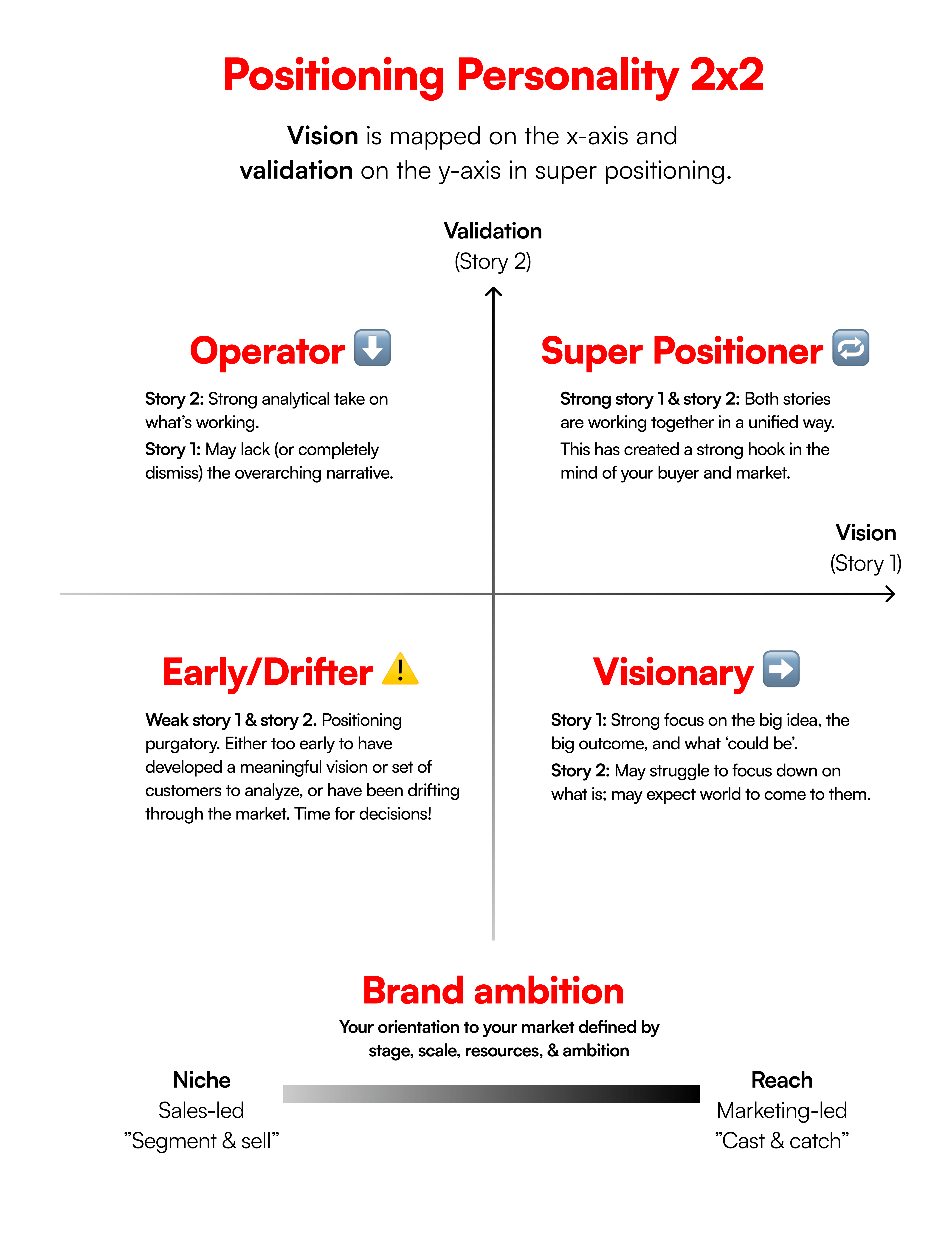
As you can see, this gives us:
- Super positioners: You’re scoring close to 15 and have nailed your story 1 and story 2 positioning across the vision and validation axes.
- Visionaries: You may be strong on story 1 vision but weak on down-with-your-customers validation.
- Operators: Or you may be excellent at understanding the story 2 customer-specifics, but struggle to bring a new vision to them.
- Early/drifters: You’re too early, or have been drifting in the market without much deliberate positioning, and are stuck in positioning purgatory.
Add on your brand ambition, and, for visionaries and operators, you might be a:
- Visionary with Niche Ambition: You have big ideas, but you’re happy to test them in a small niche.
- Visionary with Reach Ambition: You want to go all out and ‘create a category.’
- Operator with Niche Ambition: You’re happy to focus on a niche and take a very methodical approach to studying the needs of your ICP and gaps in the market.
- Operator with Reach Ambition: You’re about building sophisticated GTM plans to reach the mass market.
I know we all love to see ourselves in (often fairly dubious) personality quizzes, so don’t take this too seriously. Maybe it highlights some strengths and weaknesses, but the point isn’t to box you in. I want to show you the possibilities you may not naturally consider — maybe you should be more of a visionary! Maybe you should just focus on a niche! Keep those things you might otherwise dismiss in mind as we go through the rest of the book — you might be surprised what you’re open to by the time we’re done.
Compounding & the super positioning whole
We now (hopefully!) have a bunch of strategic specifics that we can work into your broader positioning. Awesome! Good on you for making it through this first positioning exercise. Your collection of specifics probably feels a bit loose and disorganized at this point, and that’s totally fine. In the next chapter, we’ll get more organized with your strategic narrative, and then we’ll really boil things down for your strategic, customer-facing messaging in the chapter after that.
You might also have a sense of the kind of story you don’t have. And, again, that’s fine — this is also a diagnostic exercise to see where you’re strong and where you could use help. There are plenty of insights and examples to come to help you fill those gaps.
But where are we going with all of this?
There’s something bigger you need to keep in mind as the super positioning quarterback for your startup, too.
In super positioning, however, we’re not trying to land on The One Decisive Specific that will make the rest of the market cower before us; we’re trying to find a collection of integrated specifics that create something greater than the sum of its parts. That’s the new ‘whole’ we’re trying to get to.
This is the difference between silver bullet thinking and compounding thinking.
Everyone loves to try and zero in on THIS tactic or THIS approach or THIS feature that will take your growth to the next level, but the reality is always AND instead. And, and, and. Relevant AND useful AND memorable, for example. It’s bringing those most powerful ideas together and giving them time to marinate that helps you eventually build a company that’s just so recognizably that company.
Notion
Take a company like Notion, for example.
We’ll discuss this more later in the book, but they had a strong story 1 vision (user-built software and a highly novel product), they developed a clear story 2 pitch out of necessity (an initial focus on wikis, docs, and project management), and they wrapped it up in a very distinctive brand (including their initial black-and-white visual assets).
And, and, and. That’s the compounding approach. Bringing these things together achieved the final brand goal of creating a memory association between a wide variety of productivity tasks and their product, giving them a lot of reach.
That’s what we’re aiming for — bringing all three of these prongs (→ ↓ ⟲) together in a novel, unified, and compelling way.
Drift
Likewise, as we’ll touch on Drift again in our ride it chapter, but Drift took an existing technology (web chat) in a competitive space and built a super position through compounding choices. They very deliberately rode a wave (the rise of messaging — their story 1), found a very specific differentiation opportunity in a specific industry (use chat, not forms, for sales and marketing — their story 2 ), and owned it with a very distinct brand (remember the lightening bolt?) along with an owned concept (‘conversational messaging’). That made them, for a time, one of the most recognizable brands in the industry — a brand that was, inexplicably, almost wiped from the face of the earth post-acquisition!
Strategic specifics to strategic narrative
Compounding choices are the essence of strategy, and ideally, that ‘whole’ you build engages as much of your target customer’s brain as possible. That’s why super positioning is about engaging the right-brain radar, left-brain laser beam, and brand memory all in one unified whole.
But how do you get the team aligned around that, on the one hand, and have something to put in front of actual customers to get their reaction, on the other?
You need a strategic narrative, and that’s what we’ll look at next.

Thanks for reading — let's chat! :)
Enjoying the book?
Buy on Amazon →