Prong 3: Go broader — brand, synthesis, & 2x2s
Maybe Dunford’s approach resonates with you if you lean towards the left-brain mode of attention, or maybe you actually prefer the big right-brain category story. If you do, that’s fine — venture-backed startups are about becoming the megahit, after all — but getting there can require going narrow first.
Those are the two broad B2B approaches that reflect our two modes of attention. But remember, there are three prongs to super positioning, and the third is memory. This requires giving our framework a bit of a B2C twist.
I don’t think about you at all
Here’s the gist. Some highly influential marketing academics think (with an amusing degree of left-brain certainty) that whether you go for the big change story or the narrow one, either way, you’re flat-out wrong.
Customers, in this view, are “uncaring cognitive misers” who don’t care about your story 1 or story 2.
In fact, to channel Don Draper, they don’t think about you at all.
Any marketer, in this modern brand world, who thinks they can earn the loyalty of a set of customers by segmenting, targeting, and positioning around them (the “STP” approach) is fooling themselves.
The evidence, they argue, says the opposite — it’s the bigger brands that reach more people (especially light buyers in B2C) that earn more loyalty. Not that customers are especially brand loyal anyway — if you want to maintain your brand memory, i.e., your position in the buyer’s mind, you’d better keep advertising consistently and broadly, or you’ll soon be forgotten.
Therefore, in this world of B2C mega brands, positioning is out. So is differentiation. And persuasion, message comprehension, and appealing to reason — in the bin, all of it!
This is the brutal world of Professor Byron Sharp’s 2010 book How Brands Grow, which is one of the most influential modern books in mainstream B2C marketing. Applying those principles alone to the world of B2B tech sales would obviously be highly career disadvantageous, to put it mildly.
B2B != B2C
The key difference in B2B is that ACV can be very high, sales, as a function, can therefore exist, and you actually can then narrowly segment, target, and position for a specific set of customers, especially if you’re a startup trying to break into the market!
The B2C marketing folks like to talk about marketing as a science, but in B2B, the physics of markets have some fundamental differences.
Nevertheless, in the spirit of studying successful messaging, what was the narrative that drove this academic work to such heights of influence?
It’s our old “go bigger”, story 1 approach! With a very clear from/to, old way/new way transformation to boot!
Old way/new way
The old way, from How Brands Grow, was “marketing managers [who] operate a bit like medieval doctors – working on anecdotal experience, impressions and myth-based explanations.”
Ouch.
The new way is the science-based way backed by evidence and scientific ’laws.’ The promised land, then, is effectiveness — brand growth through science-driven enlightenment.
Note there’s a strong focus on a dominant strategy here. While the common (and deserved!) criticism of How Brands Grow is that it’s more a case of How Big Brands Stay Big, it’s still important to know what big brand land looks like. Even if you’re a startup trying to break into the market where it doesn’t initially apply, it helps to know where you’re headed. Again, even if you start small, you need to know what ‘big’ looks like, and for our third prong of super positioning, that’s being super memorable.
While How Brands Grow has its roots in the B2C world, these ideas are making their way into the B2B world if the number of LinkedIn posts about them is anything to go by, especially as SaaS gets increasingly commoditized and the old B2B playbooks from the 2010s run out of steam.
For our purposes in the B2B world, the most important idea we’re going to steal is the idea of brand as memory association. This is where it comes from — How Brands Grow and the work of Sharp’s Ehrenberg-Bass Institute (EBI).
The most important search engine
Why are memory associations a fundamental part of super positioning?
To quote the EBI and LinkedIn’s B2B Institute:
“The most important search engine is still the one in your mind.” This statement makes a profound point all marketers should internalize about buyer behavior: most purchases start not by searching Google, but by searching our memory. If you believe most buyer behavior starts with memory, it then follows that the primary job of marketing is not to generate clicks, but instead to generate memories.
That is to say, memory is a very big part of how people buy.
So while the B2C folks can get a little blind-men-and-the-elephant’s-tail, shall we say, that still is a profound insight into the role of marketing and what creating a position in the buyer’s mind actually means.
It’s also neat to see how the EBI created a super position with their theory, too. Like Play Bigger, if we put aside what they say for a moment and look at what they do, we see:
- A strong, right-brain, story 1 pitch to put on people’s radars (this is the new way!).
- In a focused, left-brain sense, they have a well-defined set of buyers that care a lot about that story (big brand CMOs).
- They’ve worked hard to create a strong memory association in the market, specifically that they are the source of scientific marketing truth (so please fund our research).
That’s not a bad way to position brand management itself!
We won’t dwell on this prong too much here, but we will pick up what being super memorable means for B2B startups in our ‘own it’ strategy chapter. Part of it includes having a strong commitment to message discipling, which we’ll touch on when we look at strategic messaging in chapter 10, too.
Synthesis
That was a speed run of the three prongs of super positioning! Go big, go narrow, or go for memory and forget the idea of segmentation altogether.
These are all useful tools to have when it comes to building a winning super position in your market. The problem is they’re often presented as absolute — or near-absolute — choices. Change narrative or value positioning. Story 1 or story 2. Category or brand. Brand or positioning. And so on. You have to choose!
But do we?
If one of these approaches works for you, great. But if you’re stuck, you might wonder why, and in my experience, both for marketers, sellers, and founders, getting trapped in one mode of attention can be a huge obstacle to growth.
My experience at The Unicorn, which spent the big bucks on narrative, demonstrated the limits of the story 1 alone approach.
That was all vision and narrative with no analysis, with little getting into the weeds with the product or their customers to develop their story 2 about how to manipulate the world in a new way.
The reverse can be true, too. Just as I was reviewing this chapter, I got the newsletter update of an interesting B2B SaaS I’d been following for several years.
This company had built a powerful platform, and they were doing all the ‘right’ positioning things, specifically loads of analysis to try and find which customers got the most value out of their tool.
But it still felt like they were going around in circles.
They’d spent years building a competitor to your Airtable, Notion, and Linear-style tools, but despite building it, no one much had come. Why? Well, it was all very story 2, with varying degrees of competitive differentiation but no clear, right-brain, story 1 narrative to put it on folks’ radar in the first place. They were stuck too deep in the jar to see what the actual label should be. There was no meaningful hook.
I really felt for these folks because I could see the attention trap they were caught in so clearly. It was all left-brain laser beam — analyzing the features they should build (and building them), analyzing the customers that kinda sorta got it (and trying to position around them), and being stuck as to where to go next. Build and analyze, build and analyze, but no bigger-picture story 1 to connect it to.
The reality is that we need a balanced, holistic approach to positioning. The good news is that McGilchrist gives us one. Both left-brain laser beam and right-brain radar approaches can work — especially if you bring them together in the right/left/right jump. But if you get caught in one or the other and can’t adapt, you get stuck, and that’s what we want to avoid!
Super positioning 2x2s
I wouldn’t be doing my job as a consultant without giving you a couple of 2x2s to ponder.
We’ve discussed our fundamental modes of attention — the right-brain radar and left-brain laser beam, and how they apply to traditional narrative and positioning approaches, and ultimately result in a brand memory, the third prong in the super positioning system.
They’re the positioning tools for how, as I like to repeat, you get known, chosen, and remembered.
But — and this is my spin on the theory — we can also think about the quantity of attention we pay to things in the world as well.
For example, the quantity of attention a prospect might pay to the CRM they’re considering purchasing for their sales org with 1000 reps is several orders of magnitude bigger than the drink they opt for while at the gas station on the way home.
Therefore, if we’re going to map out attention, we need to consider both the mode and quantity of attention prospects use. That gives us this handy 2x2 of attention.
The Attention 2x2
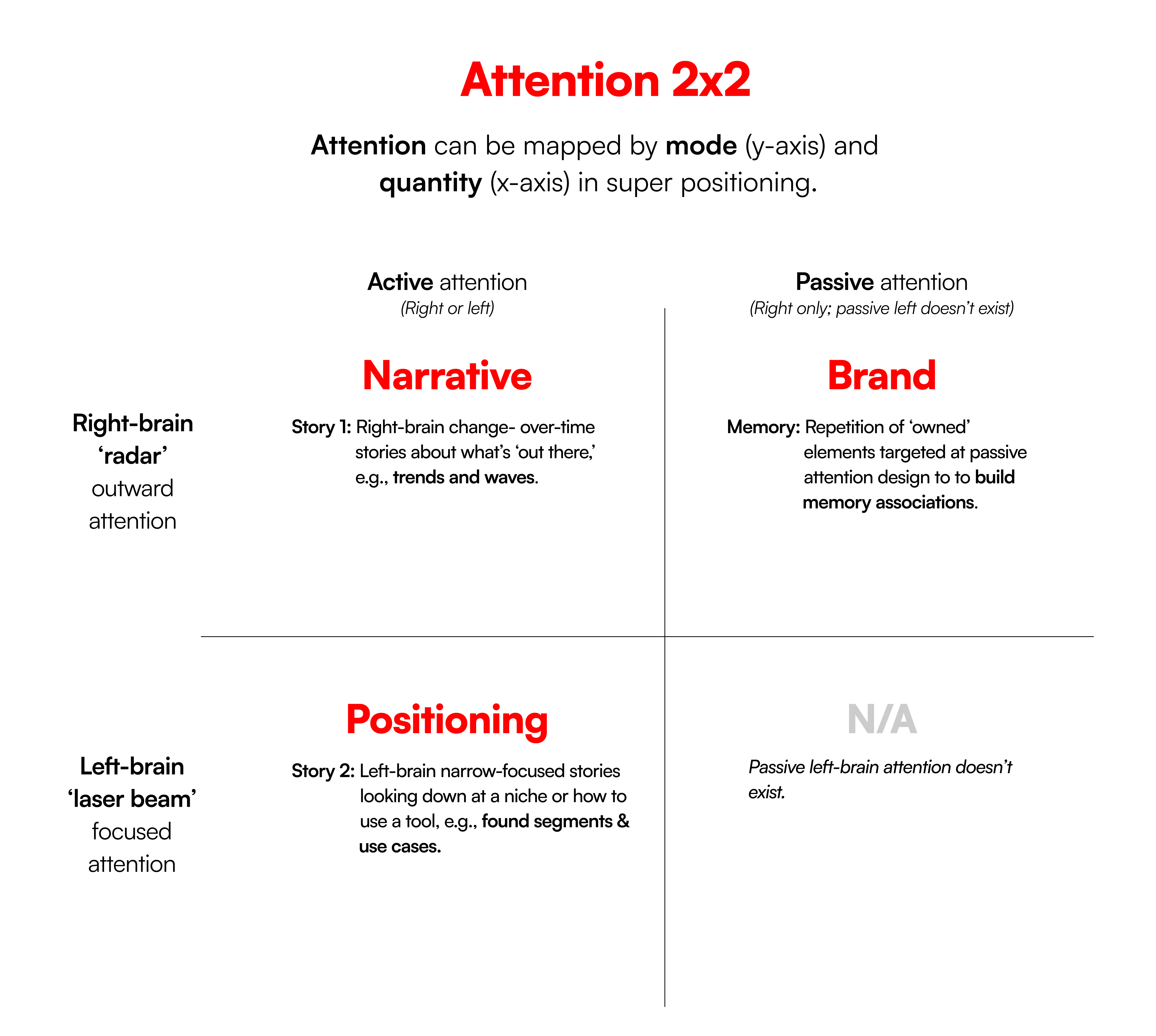
Here we see our three prongs as practical attention/technique matches, which gives us:
- Change-over-time narratives for active right-brain attention.
- Niche-focused positioning for active left-brain attention.
- Brand building for passive right-brain attention.
- There’s no fourth kind of attention because, for our purposes, passive left-brain attention isn’t really a thing.
From here, we can derive our four super positioning strategies — wave riders, problem finders, brand builders, and combiners.
The Super Positioning 2x2
Next, if we layer on what you actually do to enact these strategies, we get: ride it, find it, own it, or combine it (with apologies to Daft Punk), which gives us this 2x2:
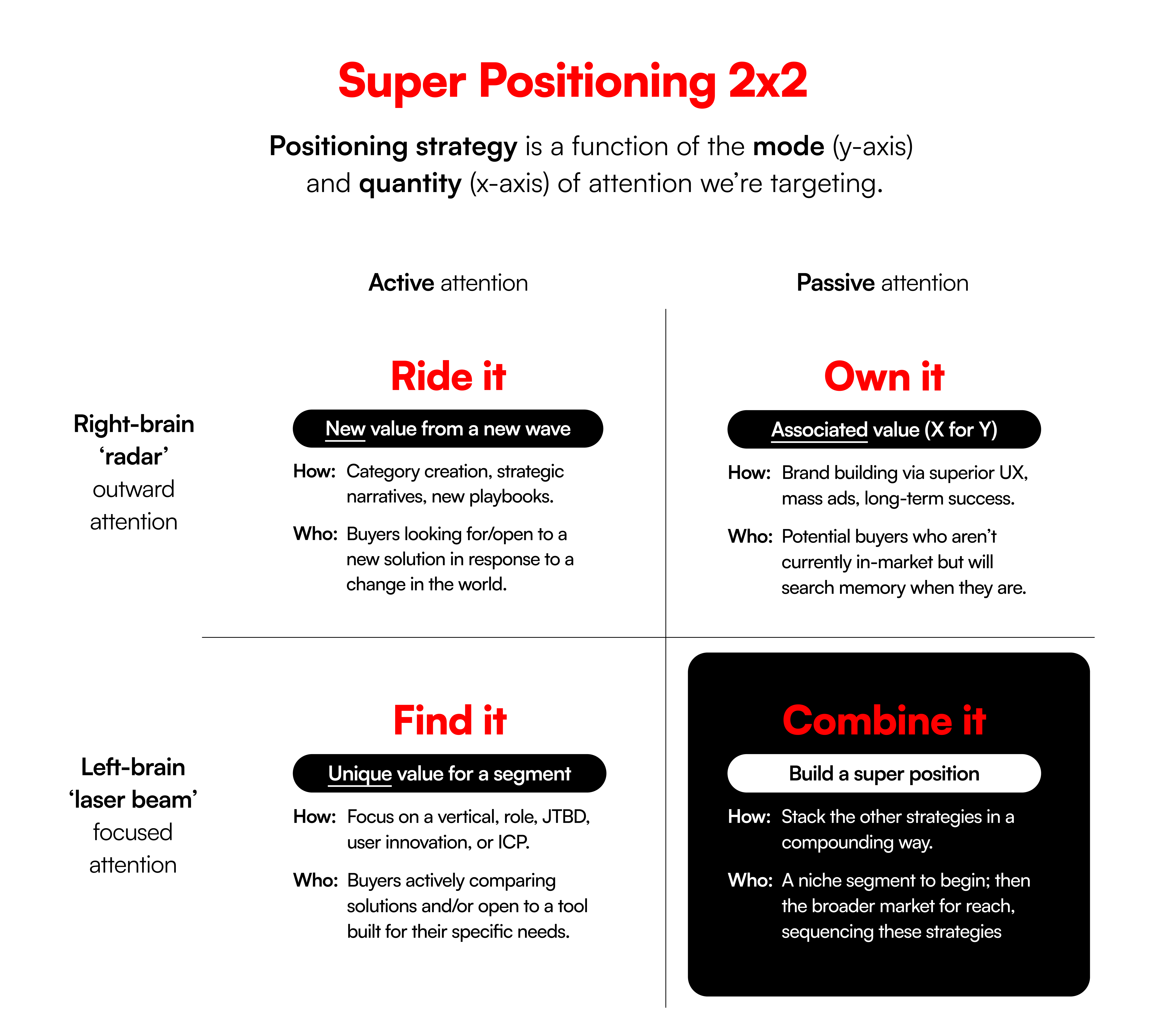
If this is all a bit much, don’t stress, because we’re going to unpack these four strategies, with plenty of examples, right after we dig into your strategic specific, narrative, and messaging, which is what we’ll explore next.

Thanks for reading — let's chat! :)
Enjoying the book?
Buy on Amazon →