Prong 1: Go big(ger) — categories & narratives
The first prong in super positioning is change stories, and the biggest proponent of the biggest kinds of change stories — category creation — was 2016’s Play Bigger, as we touched on last chapter.
Play Bigger didn’t invent category creation, however.
It was first popularized by the two positioning OGs — ad-men-turned-strategy-consultants Al Ries and Jack Trout.
(Ries & Trout popularized “positioning” itself in the late ’60s and wrote the seminal book on the topic: 1981’s Positioning: The Battle For Your Mind.)
In 1985, Ries & Trout alluded to category creation in their book Marketing Warfare, writing “A flanking attack often hinges on your ability to create and maintain a separate category.”
By 1993, they’d turned it into one of their “laws”, writing in The 22 Immutable Laws of Marketing that the second law was “The Law of the Category: If you can’t be first in a category, set up a new category you can be first in.”
Eddie Yoon would briefly pick up the idea again in 2011 (and 2013), writing a short piece for HBR on why “Category Creation Is the Ultimate Growth Strategy,” paving the way for what was to come by labelling innovative businesses as “category creators.”
You can see the 2011 blip on this Google Trends chart:
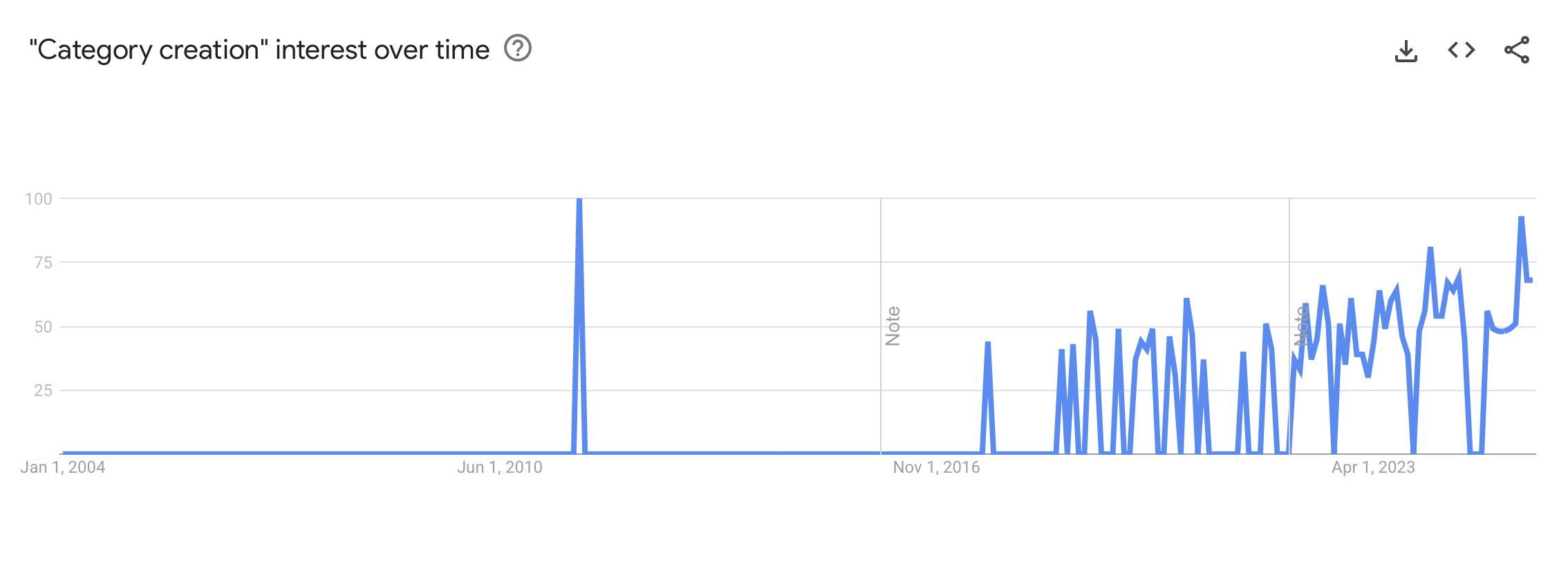
But otherwise, it was all quiet on the category creation front.
Then Play Bigger happened.
Play Bigger turned category creation up to eleven. The authors — Al Ramadan, Dave Peterson, Christopher Lochhead, and Kevin Maney — weren’t shy of a big change story. They claimed their approach superseded all that had come before — including Ries & Trout.
In fact, the Play Bigger authors humbly submitted that, in the great tradition of American pop business books, their theory of category creation explained not only all business success ever, but indeed more or less all human success ever, from Google to Gandhi. (By the end of the book, you’re left wondering if the Big Bang was the original category creator because it ‘created the category’ of a habitable universe.)
Unfortunately, it turns out there isn’t much you can learn about B2B SaaS by trying to draw a line between Elvis, Paul the Apostle, Lenin, Peter Drucker, and Salesforce.com. (Yes, that’s really what Play Bigger does!) But that didn’t stop them trying.
Here they are introducing their own category (so to speak) in Play Bigger, the concept of ‘category design’:
Category design isn’t just positioning or branding. We have great respect for the seminal 1970s book Positioning, by Al Ries and Jack Trout. Their sense of positioning as a necessary discipline was on the mark for the late twentieth century. But in this century of mobile/social/cloud, dynamics have changed, and positioning is only one part of category design. And as for branding—we call branding agencies “tattoo parlors.” You don’t want to wake up with Mike Tyson’s tattoo on your face, so don’t let someone else tattoo you. Brands don’t make a category king. Category design does.
I think the book makes as much sense as the Mike Tyson tattoo riff above (what?). I think we deserve serious frameworks grounded in reality, not a fever dream that sounds like the start of a corny joke. (A Christian apostle, a Marxist revolutionary, and a SaaS CEO walk into a bar…)
Nevertheless, I do have some sympathy for the need they were trying to address
That’s why, with super positioning, rather than taking a top-down approach of trying to find some commonality between Everyone Who Ever Did Anything Great Ever, we take a much simpler approach of working from the bottom up from our brains and how they attend to the world.
Here, however, I want to get a little meta and analyze how the Play Bigger authors deliver this message, because it’s one heckuva change story and the result was very impressive — they successfully meme’d an entire industry (venture capital)!
The change story
If you go back over the quote above, you’ll quickly recognize it as a big story 1 pitch. Positioning (of the Ries & Trout variety) is dead! Branding is bad! You need to ‘play bigger’ because so much has changed!
That is, they’re making their case for why their approach is now super relevant due to all this change. Story 1 pitches are very much about external change over time, and the Play Bigger folks roll everything internet (mobile/social/cloud) into a single bundle of change. That change, they argue, demands a new approach, and they’ve got just what the doctor ordered: category creation and ‘category design.’
While I think “category creation” is fundamentally a bad metaphor, again, I get why people liked the concept. It seemed to speak to everything that’s exciting about startups and tech — big innovation, unique business models, and once-in-a-generation success. That’s exciting to anyone interested in business. Even if your reality is much more mundane, it’s fun to dream about those kinds of outcomes!
The problem, however, that I and many others have noticed, is that everyone who reaches for category creation seems to grab the wrong end of the stick. I’ve seen people get tied into knots and waste months and years on fake “categories” that go nowhere.
It’s conceptual quicksand that sucks folks in — especially well-meaning CMOs and marketing teams — because it seems like the highest-order bit to be working on, especially if you’re a startup, even though it’s often a dead end.
But it illustrates a powerful point about how we understand the world and the memetic hook you ultimately want to build as part of your super position.
Metaphors and misunderstandings
In The Master and His Emissary, McGilchrist writes:
Metaphoric thinking is fundamental to our understanding of the world, because it is the only way in which understanding can reach outside the system of signs to life itself. It is what links language to life.
That is, metaphoric thinking is how we understand the world. But metaphor is also how we misunderstand the world, and category creation, as a metaphor, throws people off in a way that cuts right to the heart of our two modes of attention.
Ironically, it can be read in a very metaphoric, right-brain way and a very literal, left-brain way.
When one term can be read in two very different ways, it will inevitably leave a lot of folks confused, and that confusion can send your company on a wild goose chase that’s a distraction at best or a huge missed opportunity at worst.
First, though, here’s the more metaphoric right-brain understanding.
When strategy consultants and investors talk about category creation, their emphasis is very much on the creation side. The implicit message is you should create something so unique, so innovative, and so fundamentally different (not merely better) to everything that’s out there that the outcome is that your product or company — in a metaphoric sense at least — needs its own category.
There’s a lot of right-brain attention at work there. Not just in the fact it’s metaphoric, but what’s being evoked — change stories, what’s new, what’s ‘out there’ on the horizon.
I like that!
The problem is that most folks don’t get that implicit message. Instead, they hear the explicit “category” part of “create a category” and take it very literally. As in, you need to pull a new literal category name out of thin air for the software or product you’re making, spend months and years marketing that, hope it catches on, and then hope that, somehow, people buy your product. That’s what Play Bigger explicitly recommends, and that’s where teams often drive straight into a positioning ditch.
This is the more left-brain approach, where the focus is on the map and, well, the literal categories. It’s a product of laser-beam focus on how we split the difference between things.
Even the best get confused by this. Brian Halligan, co-founder, former CEO, and now executive chairman of HubSpot, wrote in 2024 that (his emphasis):
Creating a category is harder than it looks: HubSpot created the “inbound marketing” category. Pulling that off involved writing about a zillion blog articles, giving a jillion speeches, writing a book, running a conference, etc. We invested way more energy in creating the inbound marketing category in the early years than we did in marketing the HubSpot product. …So, when we wanted to go into the sales category, we thought we could just re-run the same playbook for “inbound sales.” Failed. When we went into CRM, we thought we’d create a new category called CMR, “customer managed relationship” software. Failed. When we released our CMS, we thought we’d create a new category called COS, “content optimization system.” Failed. In retrospect, we caught lightning in a bottle with “inbound marketing.”
I realize we’re deep in the weeds here, but there’s a profound point here that goes to the heart of why some “category creation” attempts succeed and others fail, and it can be hard to see it, even if you’re one of the best to ever do it, as Halligan and HubSpot were.
The difference goes to the right-brain and left-brain ways of seeing things, as we’ve discussed in terms of innovation and labels. Consider the difference between HubSpot’s attempts at:
- Inbound marketing.
- Inbound sales.
- Customer managed relationship (CMR).
- Content optimization system (COS).
Halligan calls them all categories, but it’s the last two that are literal categories of software — riffs on existing corporate software (CRM and CMS).
Inbound sales and inbound marketing, however, aren’t categories of software. (“Marketing automation” was the literal category of software for HubSpot’s inbound marketing.) They’re playbooks. They’re what you do as a company or as a marketing or sales department. And what’s the difference between inbound marketing and inbound sales?
Inbound marketing caught a wave — the organic digital marketing wave. That wave — originally the rise of blogs, social, and search — created the demand for a new playbook. Things had changed, so people were naturally receptive to a new way of doing marketing.
(That’s why riding a wave is the first of our four super positioning strategies, and HubSpot is one of the main examples.)
In fact, many people were already doing it in different ways, but HubSpot were the ones who could put their finger on it, give it a name, create a playbook and solution for it, and market the hell out of it. (Halligan isn’t kidding when he says it involved “writing about a zillion blog articles, giving a jillion speeches, writing a book, running a conference.”)
Those other three category creation attempts? No wave; no “category” created.
The power is in the wave, as we’ll discuss in chapter 8. It requires a great deal of astute right-brain attention to what’s going on ‘out there’ in the world, and the result you need to aim for is a new concept, not a new category of software for its own sake.
This gives us our concept = change + playbook + tool formula that we’ll explore in the strategy section, but for now, let’s discuss concept creation.
Concept creation
One of the weird parts about category creation, as an idea, is that the kinds of businesses that are celebrated category creators (like HubSpot) don’t necessarily create a new literal category of software. Google didn’t create search, Facebook didn’t create social networking, and Salesforce didn’t create CRMs.
This is where the category creation metaphor misses the mark. A better metaphor, and what people really mean, is concept creation.
New business concepts — like Google ranking pages using links, showing 10 blue links, and not plastering their results pages with banner ads, or Salesforce selling their software over the web (weird!) at the turn of the millennium — can compound in such a powerful way that you become the dominant player in your category.
While pulling off an infinite cash generation machine like Google is truly one of those once-in-a-generation feats, the idea of pursuing a singular business that makes unique choices is business strategy 101.
Here’s Joan Magretta from her excellent book Understanding Michael Porter, for example:
Managers often think about competition as a form of warfare, a zero-sum battle for dominance in which only the alphas prevail. This […] is a deeply flawed and destructive way of thinking. The key to competitive success—for businesses and nonprofits alike—lies in an organization’s ability to create unique value. Porter’s prescription: aim to be unique, not best. Creating value, not beating rivals, is at the heart of competition.
Nothing wrong with that advice. Startups are meant to be ambitious after all.
Ok, so businesses should compete to be unique, as Porter says. I like to say they should create a new concept not category, necessarily. Isn’t that a kind of pedantic point?
Pedantic? Me? Surely you jest! But we do need to do a little more untangling before we get to the bottom of category creation, because it shows why super positioning is so important.
Enterprise concepts
Category creation discourse often muddies the water between the mega winners of the internet revolution (mostly B2C companies like Google, Facebook, Netflix, LinkedIn, etc.) and the decidedly less sexy world of selling concept-driven enterprise B2B software (we’re pioneering the GEO category — SEO for AI!).
The funny thing is, there’s a better metaphor for those B2C companies (Google, Facebook, Netflix, etc.): aggregators.
(Yes, I’m still picking this category creation bone, stay with me!)
Ben Thompson, who writes the excellent Stratechery, coined Aggregation Theory back in 2015 to describe these companies who succeeded thanks to their ability to aggregate the infinite content the internet enables.
By aggregating it in one place (Google for the web, Facebook for social connections and then social slop, Netflix for media originally, LinkedIn for professional connections, etc.), they become increasingly useful to both creators and users, which makes them incredibly sticky (and profitable!) businesses.
In B2B — and this is my thought, not Thompson’s — you can think of category leaders as aggregators of industry demand that they solve with their platform, ecosystem, and support services.
That’s why incumbents are so hard to dislodge and why customers naturally gravitate towards them — the incumbent (and its vast ecosystem) is more likely to have come across, and created a solution for, whatever unique needs the customer has, even if it’s at the cost of product purity. (That’s why “enterprise software” isn’t exactly synonymous with “delightful experiences.”)
The more they’ve aggregated, the lower the risk for a customer to buy them, and the easier it is to get a deal done.
Aggregation Theory is a fantastic framework that comes from the Michael Porter lineage of positioning as business strategy, where we can analyze where a business sits — i.e., its position — in a value chain that runs from supplier to end user or customer. It has far more explanatory power than anything to do with “categories” to explain the success of those firms, and yet the much more crude “category creation” caught on in the VC world.
But why did “category creation” as a term win?
Because it had a super position!
The ‘problem’ (so to speak) with Aggregation Theory is that Thompson had no need to market the theory beyond promoting it to his audience for their intellectual edification.
Category creation, on the other hand, is a product of consultants (those pesky consultants!), and the Play Bigger folks marketed the hell out of their theory and created the strongest position.
They had the big narrative, the specific competitive playbook, and brand message repetition that created a name/need association between “category creation” and “big winning startup,” as I touched on earlier. That’s what creates a super position. (That, and the endless confidence to hammer everyone over the head with the concept.)
The best product — or theory, in this case — doesn’t always win, and it was ever thus.
Meaning wins
These ideas only stick if the latent demand is there. For an idea like category creation to take on memetic proportions and basically meme a whole industry (venture capital in the late 2010s), there must be some strong demand for it to tap into, and beyond language, which I touched on earlier, one of the biggest sources of demand is the need for meaning.
Play Bigger succeeded for a time because the language of category creation gave founders and marketers a greater sense of meaning in what they were doing.
They weren’t just doing boring ol’ B2B marketing anymore (*yawn*), they were creating a category! They weren’t just marketers, they were category creators! That’s not just category creation, that’s identity creation. There’s a whole pre-packaged identity there waiting for you if you buy into this world — one that differentiates you from your behind-the-times peers.
That’s a lot of meaning. You and I might find it all a bit eyeroll-inducing, but there’s a lesson in there, especially for B2B. People — newsflash — generally don’t find their white-collar work to be super inspiring or meaningful. If you can give them an identity and narrative to adopt that does make their work seem more meaningful, then that increases the chances they’ll adopt your concept. And that’s what worked for category creation and Play Bigger.
Maximal ambition
In super positioning, we aim to dial this kind of story 1, right-brain new change/new way attention up or down depending on the context we’re operating in. But what did dialing it up — way up — look like for the Play Bigger folks themselves?
Well, if we study what these consultants did, not just the explanations of why they did it, an interesting pattern emerges. I think of this as the meta Play Bigger playbook, and it looks like this:
- Coin a new phrase (such as ‘category design’ for their own work).
- Declare it a new discipline.
- Describe a playbook for that discipline.
- Suggest the company go all-in on it.
How did this play out? Here are a few examples from the book on Macromedia, Qualtrics, and Play Bigger itself), along with a more recent attempt with B2B SaaS whiteboard “visual work platform” Mural.
Across these case studies, we see:
- A simple concept name: ‘Experience design’ (Macromedia), ‘Category creation’ (Play Bigger), ‘Experience management’ (Qualtrics), ‘Collaborative intelligence’ (Mural).
- ‘A new discipline’: For Macromedia, “experience design” would be a “new discipline” that would be “part of the fabric of the technology industry”; for Qualtrics, experience management would be a “new business discipline”; for category creation itself “we believe it’s time to develop a new discipline called category design” (their italics); and for Mural, they would introduce a new discipline called “Collaboration Design”.
- A new playbook: You can’t have a new discipline without a new playbook, and Macromedia suggested Rich Internet Applications (or at least a web design suite of tools) was the future; Qualtrics had a specific view on closing the “experience gap” (”the difference between what a business believes is happening and what’s actually happening”); Play Bigger was, in part, a literal playbook for market strategy; and Mural had a playbook they acquired (LUMA, and their “LUMA Institute”) that was supposed to result in the “Collaboration Design Institute™.”
- Going all in: Macromedia didn’t just float a concept, they put their money where their mouth was with an (at the time) bargain bundle of tools; Qualtrics made “XM” (for “experience management”) a core part of their brand (even their stock ticker was $XM); Play Bigger claimed anything and everything was category related, stretching their concept further than perhaps any business concept has been stretched before; and Mural ended up with, well, concept soup: Collaborative Intelligence, Collaboration Design, LUMA, Institutes/CDI, and that’s before we get back to the actual product: Mural.
(Quotes without links are from Play Bigger, and while I’m cherry-picking examples a little bit here — sometimes they did just focus on literal categories of software — I think you get the gist.)
Note the concept focus here. This new terminology, (supposed) new discipline, new playbook, and new branding all exist around the product.
It’s an approach that, at its best, is about innovating at the concept level, not the technology or product level, per se. Ironically, it doesn’t have much to do with literal categories of software, either.
It’s also highly B2B-centric. The great flaw at the heart of Play Bigger’s often-absurd category creation claims is that the playbook outlined above has absolutely nothing to do with their choice of “category creators” (Google, Facebook, Netflix, Elvis, Gandhi, etc.). They didn’t follow any of these steps around new concept names, disciplines, and playbooks. The actual playbook here is highly B2B-centric, which is why B2B investors ran with it.
In super positioning terms, however, we can understand what’s going on. We can see that, in practice, this is about innovating around what you put on buyers’ right-brain radars. It’s not about the product-level innovation they get hands-on with. It’s about the big ideas for execs and leaders that gives them a new way to think about what they’re doing.
Or so the theory goes.
Occasionally, in the B2B SaaS world, this works a treat. Qualtrics, with their XM or “Experience Management” concept, is probably the poster child there. Huge respect for that work, which we’ll unpack a bit more in subsequent chapters.
Sometimes, however, it flops. Mural’s “Collaborative Intelligence” category has been scrubbed from existence for example and, to be honest, just wasn’t that meaningful. But hey, can’t win ’em all.
Description not prescription
I should be clear that I’m not prescribing the Play Bigger approach here — we’ll look at a much more concise, concept-driven approach when we dig into wave riding in chapter 11 — but I want to state that, as much as the word nerd in me might dislike category creation as a metaphor, there are useful tools there, and if they work for you, great.
Alright, that’s that bone thoroughly picked. I hope it at least helped illustrate what the maximal right-brain, put-something-new-on-their-radar approach looks like.
It’s not the only approach at this end of the spectrum, though.
Another take on this kind of change story comes from Andy Raskin, famous for his strategic narrative methodology, which follows a similar story 1 pattern.
The strategic narrative
In chapter 9 we’re going to get hands-on with you writing your own strategic narrative using the super positioning approach, but we’ll just touch on the classic approach here. To paraphrase Raskin:
- There’s some big change ‘out there’ that’s external to your company.
- It’s high-stakes, do-or-die stuff.
- There’s a promised land on the other side.
- Our tools and features will help you get there.
When a narrative literally starts with change that’s happening ‘out there’, you know you’re starting with a very right-brain approach to your story.
Also, isn’t that what we just saw with the category creation folks? I don’t mean in terms of ideas, I mean in terms of rationale — there was a big change (mobile/social/cloud), it’s high stakes with winners and losers, there’s promised land (‘category kings’), and tools to help you get there (‘category design’).
I mean, kind of, yes! I’m not suggesting any relationship between the two at all, but it shouldn’t be a surprise that similar approaches to change stories exist, because they’re all trying to target the same underlying mode of attention — the right-brain radar.
That’s one of the universal parts of super positioning — these right-brain, story 1 style pitches. Raskin, to his credit, articulated it very concisely in his strategic narrative approach.
You can see how, in both approaches, there’s a lot of story 1 context-setting before the shift down to any story 2 specifics around a product and its features.
Category creation focused on the name of the category.
Raskin’s strategic narrative focused on the name of the change.
In super positioning, either can work; the point is just that you have a concept that ultimately helps you transcend your category.
That might seem like a nuanced point, but it’s not. The metaphor you choose matters. The metaphor you choose for your own product and playbook matters, too.
Competitive positioning
This is big right-brain stuff, after all — change over time, the new, the global, the opening up to new possibilities, and the integration of a new reality.
But what happens in the left hemisphere when it comes to competitive positioning? That’s what we’ll explore next.
(Want to get hands-on with your strategic narrative instead? Jump to chapter 9 to explore narrative or chapter 11 to look at right-brain strategies and examples.)

Thanks for reading — let's chat! :)
Enjoying the book?
Buy on Amazon →