Own it & associate value with your brand
Own it in a nutshell:
- Goal: Find a way to be super memorable to your audience.
- Strategy: Build your brand through associated value in the form of a tight name/need memory association.
- Attention: Passive right-brain (i.e., open but not currently in-market).
- Action: Own it — you need both consistency and frequency in broadcasting a message you own.
- Position: When a buyer needs X, they think Y — your brand. That’s the position you own in the buyer’s memory.
The third prong of super positioning is brand. This is mostly the domain of the B2C world where the marketing science gurus of the Ehrenberg-Bass Institute’s (EBI), led by Professor Byron Sharp, have enormous influence.
Their view, based on big B2C brands, is that positioning is inherently a mistake and not how you grow!
These folks tend to study mass market advertising for consumer commodities (including B2B commodities, to be fair), not innovative products that startup and technology companies are trying to ‘diffuse’ into the market. (Diffusion science has been popular since the 1960s, as we discussed when looking at waves.)
But because super positioning is about the synthesis of seemingly incompatible views and solving positioning’s elephant problem (‘It’s a tree trunk!’ ‘No, it’s a rope!’ ‘No, it’s a spear!’), we can still learn from the brand folks when they’re right and ignore their blind spots when they’re wrong.
And in terms of being right, they have an incredibly helpful take on what ‘brand’ actually is, and that’s memories, as we’ve been discussing.
Specifically, it’s a name/need association that appears first when people search their memories before they search Google. (Brand search has to come from somewhere, right?)
This matters because it clarifies what brand is not, too.
Your brand is not just your logo. It’s not any elaborate brand “meaning” or (rabbit hole warning) “purpose” some marketing folks might get carried away dreaming up, either. And it’s certainly not your sassy best friend or some object of love and affection.
Instead, it’s a simple memory/need association. Need drink; think Coke. The value of Coke as a brand has been built over decades, both as a memory association in our minds and in the physical positions they’ve built in just about every nook and cranny across the face of the earth.
That is, to use the EBI’s terms, mental availability on one hand — lots of people associate Coke with a refreshing and tasty drink — and physical availability on the other, with Coke being distributed virtually everywhere. This approach makes it very easy to buy when your memory reminds you it’s a possible solution to the thirst you’re feeling.
Coke’s brand, of course, is built on its ‘distinctive assets,’ to use a term Professor Jenni Romaniuk of the EBI has coined. Those brand assets include its logo, its use of red, and its can and bottle design. They’re the memory glue between the ads we see and the product we look for.
Brand as experience
Distinctive brand assets might help us connect advertising with a product through its brand, but why do we remember some brands and not others? Why do we end up associating certain products, people, or companies with certain needs in our minds?
Brands are built on memories, but the driver of memory is experience.
In a first-principles sense, we have to have an experience strong enough to make an impression — to catch our attention and create a meaningful memory association.
For food and beverage, this is relatively straightforward: just show the product and/or its enjoyment in intense detail! Psssshh — the can opens, the attractive model throws their head back, Ahhhh. We share the experience vicariously. Or, we see the burger patty sizzle as the camera pans around it. If we’re hungry, maybe our mouth starts watering just a little bit. Again, we’re given an experience of the product.
For tech startups, brand is often built at the consumer end through product-led growth — experience the product for free yourself, and ideally share what you make with your friends and colleagues (Figma, Notion, etc.). The better the experience and the more people it involves, the stronger your brand growth.
At the enterprise end, though, experience is less direct but no less important. Think conferences (e.g., Dreamforce), charismatic talks (founders on podcasts), learning opportunities (webinars, newsletters), a consistent and useful LinkedIn presence (e.g., Gong, as we’ll touch on below) — all of these things help add up to reasons why we might actually remember a brand association.
But there’s a difference between merely doing an activity and doing it in such a way that creates a meaningful experience for the recipient. Every company posts on LinkedIn; few make it an interesting experience I want to come back for or build into my day. One of the hardest lessons for anyone doing marketing to learn is that just because you’re doing the same activities as someone else does not mean you’re creating the same experiences.
Think about the personalities and thought leaders you follow on social media, for example. I bet they’re great at creating a high-quality, consistent experience you come back for day in, day out. Maybe they give great talks; maybe they make handy infographics; maybe they’re just funny people. All of it is about the consistency of experience.
Now, contrast all of that with basic traditional advertising, which involves plastering your logo or product name and an image on static graphics or generic social videos. That’s not much of an experience, is it? No experience, no memory, no point. That’s why so much advertising simply washes over us, or why, to create any impression at all, it has to be hammered into our minds through sheer repetition.
This is why meaningful, memory-creating marketing is rarely something you can just ’turn on.’ If you want to truly build a brand, you’ve got to have the ability to think through the experience from first to last. You also — more importantly — have to have the budget to give enough people that experience consistently enough for them to both form and maintain a memory association, such that when it comes time to buy, they think of you. That’s a rare combination!
Category associations
We don’t just experience products and their marketing individually, we experience them as part of a category, too.
Brand memory associations, therefore, also work on a category level. That’s why tech companies all tend to adopt similar aesthetics, and why fashion or sports companies likewise all tend to look just like their competitors over time. They’re all trying to tap into the memory associations of the category itself.
Branding, on a category level, is as much about positioning your company or product to fit in as it is about being unique. That makes sense because it makes it easier for buyers to, well, buy. If someone walks past a shop on the street, for example, it’s a service to them that the store looks like the kind of store that it is — fashion shops look like fashion shops; fast food joints look like fast food joints, and so on.
The alternative is aesthetic anarchy, which is a fun idea but not how our brains work. Instead, we rely on visual cues and cultural associations to pattern-match the world around us. That’s why B2B SaaS sites all tend to ’look the same,’ for example — it helps buyers understand what they’re looking at.
Sculpting your brand
Creating unique, memorable experiences while still fitting in with your category can be a fine line to walk. If buyers need common cues to understand what category you’re in, how do you stand out? How do you become super memorable despite those constraints?
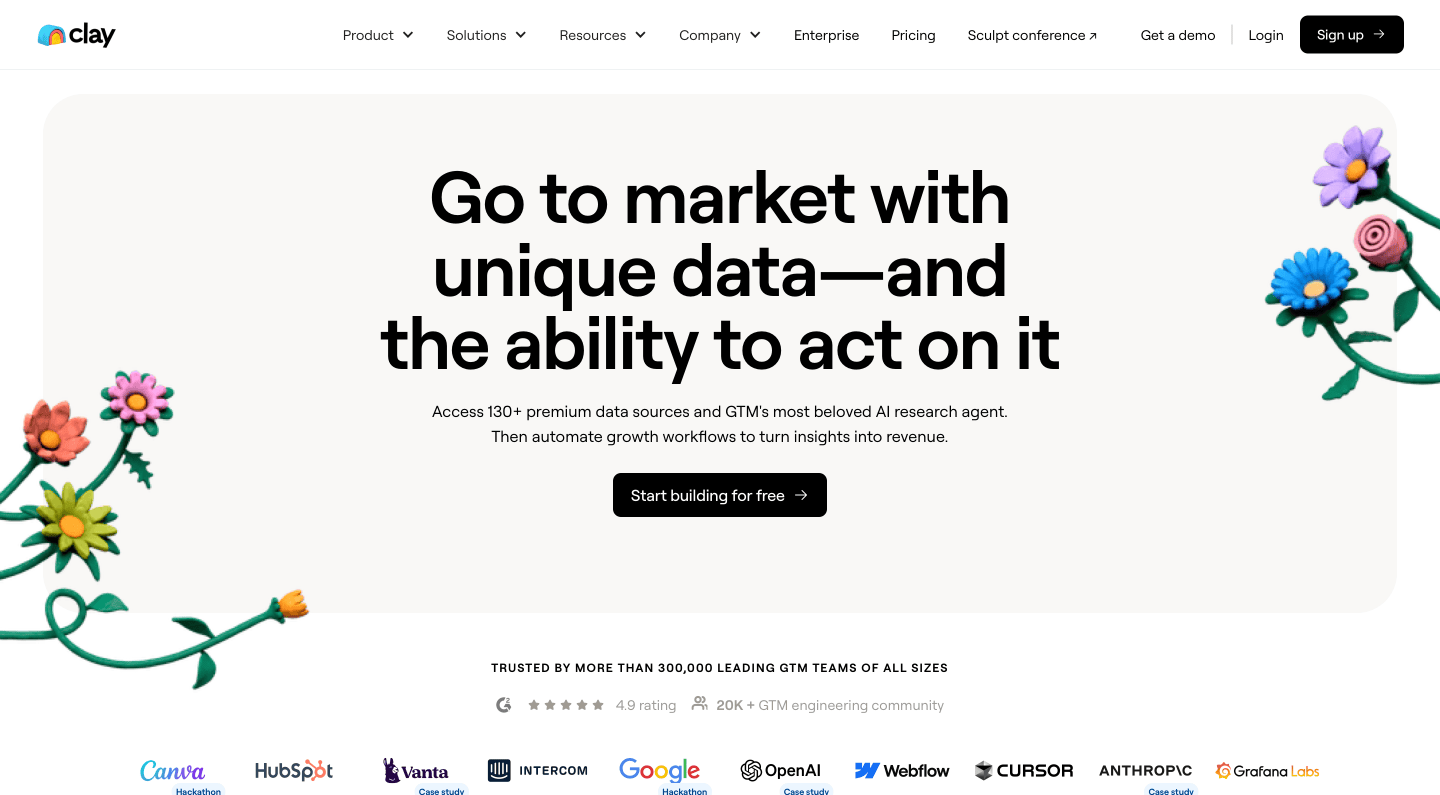
There’s still enormous room to develop distinctiveness within your category, and that’s what sales enrichment and automation platform Clay does very well. They have both a distinctive name and visual elements that riff on that name and what it means:
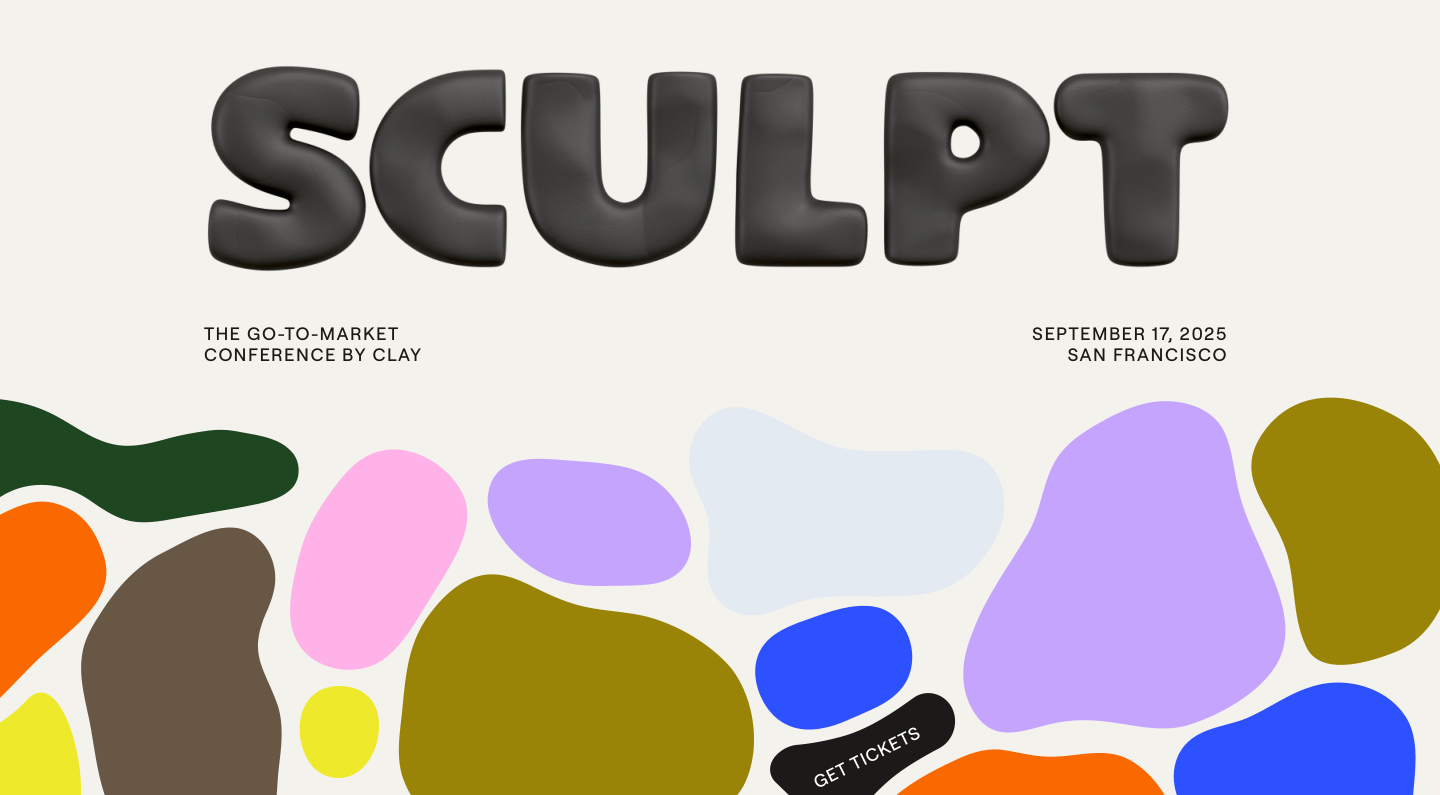
That distinctiveness extends to their conference, Sculpt, where their brand team can really run with the theme, which speaks to the malleability of the tool itself:
In an interview with First Round Review, Clay co-founder Varun Anand says:
We’ve always overinvested in brand way more so than other early-stage B2B software companies. […] When you look at other early-stage B2B startups, few invest in brand, so everything ends up looking the same. When no one else is investing in something, that’s a way to have alpha and stand out in a meaningful way.
Clay’s branding is interesting for two reasons:
- It’s distinct — they have a look they own.
- It runs through everything they do — they have a memorable position they own.
On the first point, a branding exercise that results in this kind of (very effective!) work might talk about the brand being creative, friendly, and approachable, for example. I suppose that’s true relative to the very dry and often monochrome world of B2B tech, but the bigger point is simply that it’s distinct. It works within the norms of the category but creates a coherent theme that’s theirs.
That’s one step towards being super memorable.
Building memories
Being distinctive matters, but to what end? What’s the underlying position you’re trying to build in the buyer’s mind?
The real meat of branding, including memory associations, is the need you can associate with your brand and the scale at which you can establish that association.
Startups tend to think if only their innovation was useful enough, or only the concept they created was relevant enough, then that alone will make them memorable.
That’s certainly a part of it, but the more prosaic approach to branding is that it’s more akin to spaced repetition.
Spaced repetition is where repeated exposure to information builds long-term memories and fights inevitable memory decay. (That decay is predictable by the way — you can model it.)
Spaced repetition is popular with language learning for this reason — see symbol, remember sound. See word, remember meaning. Do that only once, and you’ll probably forget it. Do it at set intervals, before the memory decays, and you’ll remember it. The same is true for the brand memories we’re trying to build.
But for spaced repetition to work, there has to be something consistent, in a positioning sense, that’s repeated.
Position-driven branding
It’s tempting to think building brand memories -> brand advertising -> running “brand campaigns,” which are amorphous things with no real definition.
But if you want to be super memorable, you need to think about branding as compounding activities that work together to build that memory in the mind of the buyer, and that’s what we’ll explore with Clay in this chapter.
Clay’s name is a metaphor (metaphoric thinking is, as we’ll see, how we understand the world!) and it comes from its roots as a flexible data manipulation tool, something akin to a spreadsheet connected to various APIs. Hence Clay — a tool for sculpting data.
But that flexibility made positioning a bit of a nightmare.
In a separate (and excellent) First Round Review piece by Todd Jackson, Clay’s CEO and co-founder, Kareem Amin, says that “getting to the right positioning is often more challenging than getting to the product itself.”
That’s a message this book can get behind. Quoting Amin (all quotes from FRR):
This is a common path — a founder starts by thinking a product is cool and then they have to narrow down the customer and the use case, start to tell the story in a cohesive, coherent way, and then the market gets it. The flow isn’t always linear; often it’s very iterative and messy and that’s entirely normal.
Clay’s breadth meant, as Jackson describes, they had too many potential ICPs. But if you read between the lines, you can see the existential struggle they went through around accepting the viable position they’d found in the market vs. their original vision.
The big early right-brain radar vision for Clay was, Jackson writes, “to make the power of programming accessible to more people,” and the dream was a broad, horizontal tool that, to my ears, sounds like a Notion or Airtable for API data.
But the vertical they settled on was sales, and the early ICP was cold email agencies in, particular. Not exactly a glamorous place to start, but that was the result of their customer vision — looking down the left-brain laser beam into who was getting the most repeatable value from the tool.
They didn’t own it straight away, however. They didn’t turn that insight into a hook. Quoting Amin in First Round again (my bold):
Maybe three-and-a-half years into building Clay, we were pretty focused on salespeople. But we hadn’t committed to that ICP in a way that showed in the product — like how we prioritized new features, or changed the language on the website.
The strategic messaging on your website reflects your internal narrative about what you’re about and the positioning opportunity you’ve found, but sometimes it can be hard to swap the original right-brain vision for the more here-and-now left-brain one.
Amin (very admirably) describes the challenge for founders in this situation:
In the beginning, I put a lot of pressure on myself with Clay because I wanted it to be both successful and personally fulfilling. As a founder, your company can become your art project, the thing that you want to be actualized through. But this actually decreased the quality of my decision-making because I would get caught in that same spiral of trying to figure out the biggest, most high-impact thing we could possibly do long-term, instead of what is actually useful right now.
Now I’ve shifted my mindset. I’ve removed the psychological pressure — it doesn’t have to be the biggest thing, it just has to be what other people think is useful.
That’s a very modest assessment of their achievements, given that in 2025 the company was valued at $3.1B. But you can see that battle of internal right-brain/left-brain attention and the struggle for meaning. Nevertheless, there’s a lot to be said for being super useful for a specific ICP.
You can also see how these big positioning bets rest on a founder/CEO’s shoulders — the idea that some lowly product marketer “owns” a company’s fundamental positioning in any organization is an attractive fiction that never matches reality. It’s a team sport to be sure, but let’s be real about who actually calls the positioning shots and how heavy that responsibility can be.
In any case, when it comes to what Clay is fundamentally about, this “own it” lens speaks to something much deeper than brand in a superficial, logos-and-colors sense. Those decisions to trade off the long-term vision for the here-and-now customer vision don’t always come easy.
At the end of the day, you need to own a position (and memory) in the mind of the buyer, and those hard decisions ultimately enabled Clay to build the brand, memory associations, and business that they have.
Customer-built growth
That approach to brand is something they’ve run with, developing a sophisticated ecosystem-driven approach, as Emily Kramer (of the excellent MKT1 newsletter) discussed with Clay’s Mishti Sharma & Bruno Estrella.
With a clear ICP, Clay was able to work with freelancers, agencies, and creators to get the word out and help those folks look good by showing off what they can do with the product.
That created a virtuous cycle where their users wanted to be associated with the brand, as that showed how cutting-edge they were, which in turn pulled more people in who could try the product (it’s self-serve with sales-assist).
This is reminiscent of the “customer-built growth” concept coined by David Peterson, VC and former growth leader at Airtable, back in 2021. Peterson writes:
When end users are empowered to build [through low-code/no-code tools], they also become the first (and most authentic) sales people for your product. They’re (understandably) proud of what they built and want to show it off. As they evangelize what they built to their colleagues, they’re inadvertently selling your product as well.
This dynamic is the essence of customer-built growth. What if every end user could be a node for future growth, not because they want to earn a referral credit by sharing a sign up link, but because they want to show off what they built to their colleagues or peers? Or make a living selling something they built with your product?
Along with Airtable, Peterson highlights Notion, Zapier, and Figma as being emblematic of this “customer-built growth” phenomenon. Having your users constantly showing off your product to their peers is one way to be super memorable.
While Clay presumably aspired to be mentioned in the same breath as those companies, they found product-market fit in sales enrichment, and in doing so, found something else they could own.
Back to narrative
In serving their customers, Clay has developed what they call a GTM engineering role (“basically a mix of a sales engineer, an AE, and an SDR”), built a narrative around that (“The rise of the GTM engineer”), and are now trying to own their association with this role.
That is, by zeroing in on a niche, they were able to:
- Discover something novel through their own unconventional approach to solving their needs first (how to demo Clay).
- Give that insight a name (the “GTM engineer”).
- Put that owned concept back on the radar of the market more broadly.
In their announcement of a $100M raise, for example, they led with “Clay raised $100M at a $3.1B valuation to power today’s breakout AI-native job: GTM engineering.”
Yep, they developed their own concept. In our concept = wave + playbook + tool formula, their GTM engineering concept is: No-code/AI as the wave, GTM engineering as their owned playbook/role, and Clay as the tool.
The strongest case for this concept is that it’s similar to Gainsight owning their relationship with the then-emergent role of Customer Success. The case against is that it’s a fake category creation play. In Clay’s defence, it’s based on what they’ve seen in their own GTM work; whether the market accepts it, though, remains to be seen.
Either way, Clay seems to be well on their way to building a super position:
- They caught the tail end of the no-code/‘customer-built growth’ wave and are now riding the AI wave.
- They’ve found where their unique value resonates (after years of zero-revenue exploration).
- They’re owning their distinctive brand association with sales enrichment and their emerging GTM engineering playbook.
Narrative pushback
“GTM engineering” has faced some pushback, though. To own an association in the market, the market has to accept that your narrative is based in reality. One difference between today and earlier attempts to coin concepts and define roles, however, is that marketers who are sick of having dubious new concepts put on their radar (and LinkedIn feed) now call them out.
There’s an emerging audience for the LinkedIn hater — viral, ChatGPT-assisted takedowns of whatever the trend du jour is. Even if the content of these takedowns is still incredibly corny, AI-generated “That’s not X. It’s Y.” prose, they still get likes because the core message of here-we-go-again resonates.
Personally, AI slop aside, I think criticism is healthy. This book includes a takedown of category creation after all. It just means the onus is on the concept creator to not only coin a term but prove the actual value and demonstrate that what they see is real, and not just made up.
That’s the challenge for Clay, and that’s been a theme of this book and the ride it strategy in particular — you have to prove your value. You have to own something real, and an industry having a high bar for that proof of that reality is a good thing.
Nevertheless, Clay have still managed to reach the final super positioning stage of combining it, which we’ll explore in the next chapter. It’s not about finding a niche or building a brand or creating a category concept, it’s about learning from the market as you go and making compounding decisions to build something that’s greater than the sum of its parts.
B2B ‘physical’ availability
With the right mix of ICP focus and a wave to ride, Clay eventually found a brand association — or series of associations — they and their ecosystem partners could build, ultimately creating a high degree of ‘mental availability’ in the market. When marketers and sellers thought of enrichment and AI tools, they thought of Clay. Even the mild pushback is a sign of high mental availability — when your content is worth commenting on, you’ve reached a place of significance in the market’s collective mind.
In the B2C world, however, mental and physical availability have to work together. It’s one thing to remind folks that a sweet, sugary, caffeinated cola exists with a certain logo through sustained advertising (mental availability), but you also have to make sure it’s physically available when the need strikes (vending machines, supermarkets, fast food partnerships, and so on).
What does that look like in B2B? We touched on Clay’s domination of the social environment, but what about search?
For the B2C and SMB-focused design platform/juggernaut that is Canva, that meant dominating SEO in the early days. It meant showing up for every Google search around a design job-to-be-done, ever. That was physical availability for “How to design a [card/resume/poster]” in the digital world.
These days, the race is on to get recognized in AI search (i.e., ChatGPT) for much the same reason. No matter how carefully you’ve thought through your positioning, you still need to be ‘physically available’ when it counts.
In sales-led B2B, that can take many forms, but the simplest way to frame it is: are you easy to recall and easy to buy? That means eventually being there in webinars, on LinkedIn, in the search engine result pages, at the trade shows, and so on, perhaps with a targeted outbound motion that means good-fit prospects actually encounter you.
With all of this surface area to cover, you need more than just your latest feature release or case study to talk about, too. That’s why having a strong concept to work with is so important. And that’s why Clay will always get more mileage out of “GTM engineering” for brand building and owning a message than whatever integration or feature they launch in a given month, however useful they may be. Having a concept that’s bigger than your product just creates more meaning for your brand and gives you more to talk about, all of which keeps building and refreshing those memory structures.
Brand > advertising
“Owning it” is ultimately about branding beyond mere advertising. The B2C folks will be the first to admit that advertising is a weak force, especially in the short term, so think long and hard anytime someone suggests you need to run a one-and-done “brand” campaign.
Running sustained brand campaigns can be worthwhile, though, just remember that the very best brand ads also tend to activate buyers. That is, it prompts them to buy in the short term, not just remember your product or brand over the longer term, which means they can be run indefinitely. (That’s why Squarespace was so successful with their podcast ‘brand’ ads, as we’ll touch on below.)
Advertising might be the only real lever B2C brand advertisers have to pull, but in tech, especially startups, we can build the product, playbook, UX, and entire buying experience to match the memory we’re trying to build.
That’s something Linear founder Karri Saarinen knows very well, which he explained on Twitter/X:
I was reflecting back to my time at Airbnb. I remember for [Airbnb founder Brian Chesky], the brand was the most important thing and I think it’s still very rare that tech company founders understand what is brand and how to use it.
I also think the brand is as much internal as it is [an] external thing. The brand is essentially what you are as a company, and internally it affects the culture and the outputs.
Many tech companies push products and messaging which doesn’t seem to make any sense. When Apple puts out something, it 99% of the time feels like Apple. It’s not by mistake.
The consistency comes from the fact that everyone in the company [has a] very clear understanding [of] what the company is, what it stands for, what’s the quality bar, what it does, how and why. Consistency is important for a brand, it’s like the soul or personality of your company. […]
At [L]inear [we] started with the brand from day one.
It’s that consistency that creates memories, and that consistency isn’t just in a logo or ad; it’s in all the marketing output, it’s in the product, it’s in the culture, and it all amounts to a more implicit, right-brain gestalt that makes you a coherent entity in the prospect’s mind.
That’s what owning it means when it comes to brand as a positioning strategy — creating a distinct memory association over time through impeccable standards and consistency.
Memory decay
When it comes to brand, failure state for most sales-focused tech outfits is ignoring brand entirely, thinking they’re too specialized, too sales-driven, too industry-specific for anyone to care about their ‘brand.’ That’s true insofar as you don’t have to be a cool brand, but ignoring brand altogether is a self-limiting belief.
This becomes a particular problem when executives try and cut costs, so they cut back on marketing activities. Initially, nothing changes. ‘Aha! I knew all that marketing stuff was fake!’ they think. (Sometimes it is!) But often, there’s no change because the business is still profiting off brand memories built and sustained over months and years prior.
Eventually, however, those memories decay. A couple of quarters later, pipeline coverage doesn’t look so good. Marketing is ordered to ‘Go out and get some leads!’ But if there was a magical ‘Generate leads’ button, they would have pressed it already. Spinning up marketing activities to build memories takes time. And it takes longer still for buyers to then become ready to buy and go through your months-long sales process.
Advertising to the 95%
This brings us to the EBI’s 95:5 rule of brand marketing by the way, which is a LinkedIn favorite.
The idea is that, as a loose rule of thumb, only 5% of a given B2B market is actually ‘in market,’ i.e. looking to buy, at any given time. And when they do come in market, most folks search their memories first.
Marketing is, then, largely aimed at the other 95% to build and, crucially, sustain memories so when they are ready to buy, they think of you.
The 95:5 playbook
What does this look like? Devin Reed, a content marketer for Gong, detailed their playbook on HubSpot’s blog and summerized it on LinkedIn. Reed claimed that:
I spent a year at Gong creating content for the 95% of buyers who weren’t ready to buy. We grew from 12K to 220K LinkedIn followers and generated millions in pipeline — and never talked about our product.
They may have never talked about their product, but they absolutely talked about the things they wanted you to associate with their product, like how you do sales effectively.
Also, note that this is marketing and sales folks talking about selling to marketing and sales folks so they can… sell to marketing and sales folks (LinkedIn gonna LinkedIn), but you can see the principle in action.
In a sense, social — and LinkedIn specifically — is the new inbound and content marketing strategy for this market.
Marketers once spent years creating content hoping to rank for keywords; now they spend years pumping out content through LinkedIn (and newsletters, podcasts, and so on) so they can build that name/need memory association in your mind. Need sales tools? Think Gong.
You search your memory before you search Google after all, and when you do search Google, chances are it’s then a brand search.
Associated with what?
If B2B positioning — and building a super position — was merely a matter of running the right brand ads to build your brand association, it would be a much easier game.
The reality is that it’s a compounding game that effects every part of your operation.
That’s why there’s a lot to be said about caring about consistency — in product, your message, your buyer and customer experience, and ultimately the name/need memory association you create is low-hanging fruit that benefits the whole business. Just care more.
That way, if nothing else, folks who may have interacted with you but didn’t buy from you this cycle may well come back next time they’re in-market, when they switch jobs, or when they want to make a recommendation to a friend, simply because they felt positively about you and remembered you because your brand wasn’t the equivalent of a manilla envelope stapled to a beige wall.
Owning it from the front
The thing is, though, that leadership has to own it. They’re the gatekeepers of consistency, after all. This consistency of experience doesn’t happen on its own, especially if they’re treating Marketing like a leads piñata.
The bar needs to be set by leadership so everyone knows what standard they’re aiming for, what message they need to stick to, and ultimately what kind of experience is acceptable to deliver. (That’s why a simple strategic narrative can go a long way in driving alignment, too!)
Memory builders — examples
Brand building, then, is essentially putting something on people’s passive right-brain radar consistently and over a long enough time period that a clear name/need association is built — a memory that sticks in the buyer’s mind.
Incumbents have it easy — by virtue of being the biggest, they become the safe option that ’everyone knows’, and continue to build and maintain memory associations in the market simply by continuing to remind people they exist.
Nevertheless, from a startup point of view, how do you use this kind of memory-building as a growth tool?Here are a few possibilities.
Squarespace — exploit a new channel
Squarespace built one of the strongest brands in SaaS over a number of years through their innovative, relentless, and exhaustive use of podcast advertising.
By seemingly advertising, at one point, on every podcast, ever, they built incredible brand memory associations in the market. Want a website? Have a friend who does? Chances are you think of, or recommend, Squarespace. Why? Because they’re first to mind.
This is the almost Pavlovian response that effective brand advertising over time generates. And in Squarespace’s case, it also generated immediate conversions, so they could keep doubling down on it. Their ads performed ‘double duty’ to use marketing-speak, building memories for the future and converting customers in the present.
Slack & Linear — double-down on quality and innovation
Past behavior and experience drive attitudes towards a brand, not the other way around, much to the chagrin of marketers who think they can imbue their brand with magic powers of persuasion.
Think about ChatGPT, for example. Super weird name. Standard logo. Generational innovation anyone can use for free. You can guess which of those drives attitudes for the brand.
Strong brands in tech are also often built on a superior user experience, and that was true for both Slack and Linear for that matter. Both products were riffs on existing categories (team chat and issue management, respectively). But both founders had an acute sense of their experience mattering, and that set them apart.
For Slack, the operating metaphor was that of impeccable restaurant-like service with a high bar for quality, which was established by founder Stewart Butterfield in a classic memo sent out before the product launched (as we touched on in chapter 10).
Likewise, for Linear, as we touched on above, the brand was every interaction folks had with the product and company, including a stunning homepage and incredible product UX.
The key here is the contrast — the common alternative to Linear was the long-in-the-tooth Jira, and Linear was positioned as a breath of fresh air for serious professionals who care about their tools.
This made them the first choice for early adopters who wanted to use the hottest tools. That got their momentum going, and that established their early position as the new default choice for discerning product development teams starting new projects.
Notion — go B2C2B
Brand tends to work more at the B2C end of the spectrum, and some of the best SaaS brand plays, therefore, tend to look very B2C-ish.
Take Notion, for example.
We discussed Notion as “sugar-coated broccoli” in the previous chapter, because Notion is, on paper, a pretty weird concept — docs and databases intertwined in an innovative canvas of sorts where users can create their own simple tools and workspaces.
What’s interesting, though, is their B2C2B approach. They go broad with incredibly accessible branding and marketing, get consumers hooked on the tool, grow their community, and then hope they’ll bring the tool into their workplace, which is when Notion cashes in.
That only works if the brand sticks, though. There needs to be that strong need/name association, and Notion has built just that for their project, work management, and now AI tools.
Brand as a forcing function
Brand can be a great forcing function in terms of making you think hard about exactly what clarity you want to create in the market — what need association do you want to establish in prospects’ minds? What do you want to be famous for? What’s your pithy from/to transformation or your hook?
Speaking of hooks, this is why value blobs don’t work — they don’t create a clear name/need association. What’s one term you can be associated with? (For me, I hope it’s ‘super positioning’ as a differentiator and positioning as a category association — we will see!)
If that association is going to take years to build, once you know what it is, the sooner you can get started, the better.
Next, we’ll look at what happens when everything comes together in a winning super position.
What’s your memory association?
- What’s your vision for the distinct value, or need, you want prospects to associate with your brand?
- When people think about your brand now — if they think about your brand — what’s the current associated need?
- If you surveyed 10 or 100 customers, what do you think the consensus on the associated need or attribute would be? Would there be a consensus at all?
- Is there a channel or unique GTM opportunity in your market where you can show up consistently to drive home a unique name/need association?
- How relevant is brand to how your prospects buy? Do they buy by searching their memories first, and if they do, what do they say triggered that mental search? How can you strengthen your association with that trigger?

Thanks for reading — let's chat! :)
Enjoying the book?
Buy on Amazon →