Super positioning manifesto
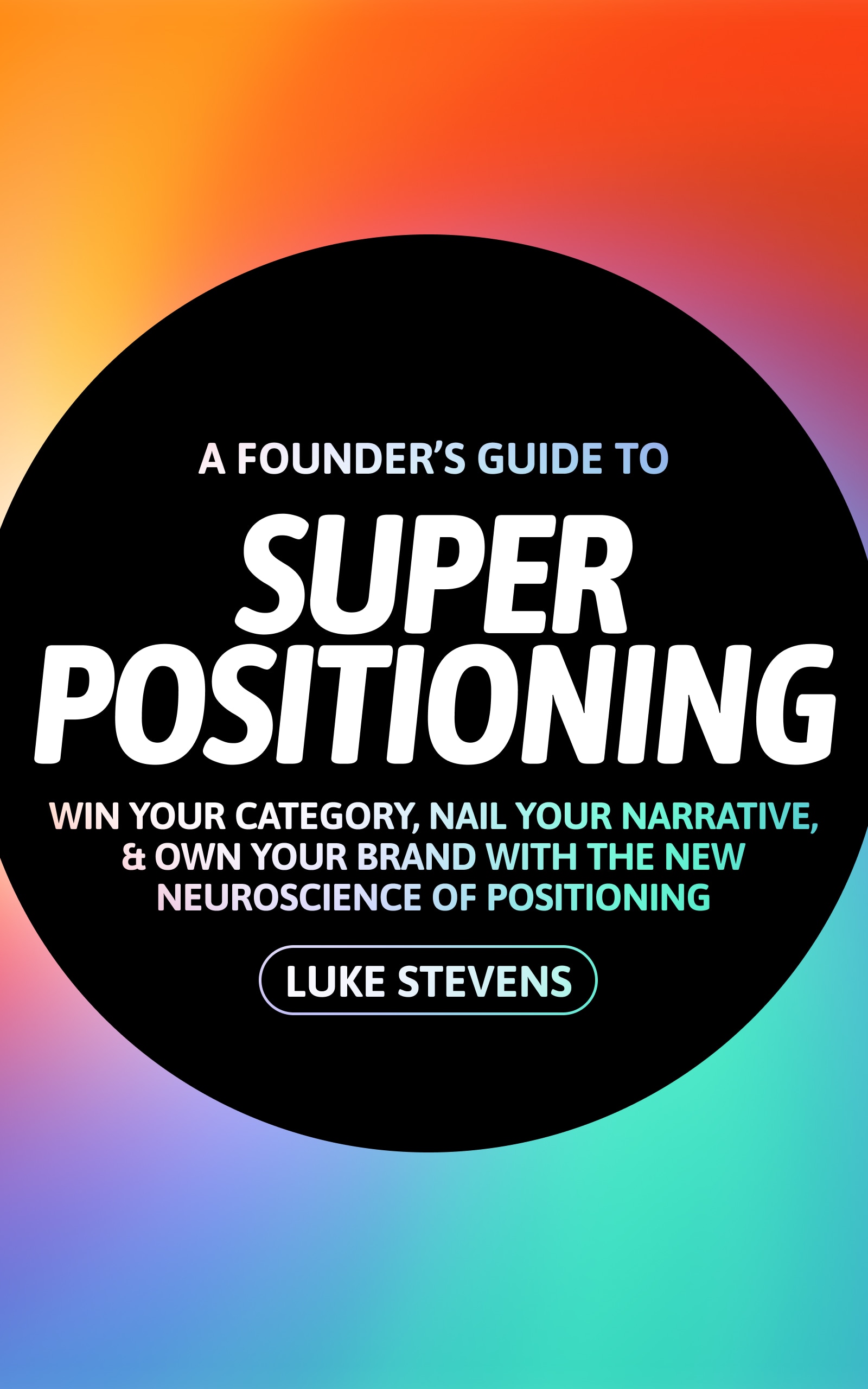
I hope you’ve learned some useful ideas from this book. The process of writing Super Positioning (and Positioning Playbook before it) was, as you can imagine, a period of intense learning for me, too.
Let’s finish where we started — on the importance of getting specific. Here are a bunch of specific beliefs I landed on that make up the super positioning manifesto.
I know we’re not trying to overthrow regimes here — just sell some software — but consider this a snapshot of the themes that drive Super Positioning that you can come back to when you need to refresh your memory.
Here we go.
Positioning is a system
Systems > spreadsheets > statements. Positioning isn’t a statement (or spreadsheet) you wish were true; it’s a system that works across your GTM motion for making a position in the mind of the buyer come true. Systems over statements.
Two modes of attention
The crux of positioning as a system — and the most important concept in this book — is the two modes of attention we all use. Two modes of attention mean:
- Marketers: Two distinct approaches to positioning (narrative vs. competitive positioning, or story 1 vs. story 2).
- Sellers: Two distinct ways customers show up in calls (radar vs. laser beam).
- CEOs/founders: Two distinct ways for you (and your investors) to see your company (outward vs. downward vision).
It affects everyone and everything. Especially in GTM.
Known, chosen, and remembered
By using and engaging those two modes of attention and creating memory associations, we want to build a narrative (the thing you’re known for), ensure we’re chosen (we’re a better choice relative to competitors), and remembered (customers form a brand memory and share that with others).
This is not just the job of marketing — though it’s what marketing exists to do — it’s the job of the entire organization, especially if you’re a startup.
Startups are about winning
The point of achieving those jobs of being known, chosen, and remembered is to win. There are multiple ways to win, but if you’re a venture-backed startup, everything must be seen through the lens of winning. Startups are about winning (or dying trying), and winning doesn’t come through headline tweaks or shallow positioning statements, it comes from executing on strong ideas, clearly expressed.
Startups are about compounding
Super positioning is the antidote to silver bullet thinking that often pervades marketing and startups. Success doesn’t come from One Weird Positioning Trick.™ It comes from finding a viable position as early as possible, creating a solid foundation. Venture capital will, as Eric Paley described, compound the strengths and weaknesses of your position, so better to make it as strong as possible as soon as possible.
Product precedes positioning
Product is the most important thing. Go-to-market starts with a product and ends with a position — or memory — in the buyer’s mind. The question is, is that a favourable memory? As Bill Bernbach said, “Nothing kills a bad product faster than good advertising.”
The point of the product is the innovation
Invention becomes innovation when it’s well-positioned. Inventing some new technology or product is great, but that invention becomes a value-creating innovation when it’s positioned appropriately in the market. In B2B, your innovation then drives productivity, and productivity ultimately drives prosperity and increases standards of living — a good thing!
Strong positions are built on unique concepts
Your company needs to compete to be unique across as many dimensions as possible. You need a product that’s different from the competition. You need a GTM motion that’s different from your competitors. You need a concept that’s bigger than your product. You need to find the simplest system that works to start (Gall’s Law), and then start stacking compounding advantages.
Better outcomes don’t require more money, they require better ideas
Poor returns come from poor ideas. We’ve all seen what a decade of so-called “category creation” combined with near-infinite VC dollars has produced — massive waste and foie gras’d startups. New ideas — and better returns — come from seeing the world in a new way. Understanding how vision fundamentally works, i.e., how we attend to the world around us, unlocks that ability to see new opportunities.
If you want to create a position in the mind, you need to understand the mind
This means rejecting neurobabble while embracing the profound new neuroscience on how we fundamentally attend to the world as humans — with two brain hemispheres that produce two fundamentally different modes of attention.
Efficient GTM motions address the mind as it is
Two modes of attention mean two fundamentally different types of stories exist. We need both — the big change story and the competitive edge, all wrapped up in a memetic hook that gets remembered. Your GTM motion needs to be built to serve those fundamentals.
Super positioning starts with a narrative
People only care about why you’re different after you’ve appeared on their radar in the first place. So that’s where super positioning starts — with a narrative — and ends in a hook.
Super positioning > narrative-ONLY positioning
Big stories are just tall tales if they don’t translate to actual differentiated value.
Super positioning > niche-ONLY positioning
If positioning is only about niches and never about narrative, then you’d never get HubSpot, because they would have given up after starting life targeting the legal niche as LegalSpot.
Super positioning > fractured positioning
Our brains process information from the whole and what’s new (narrative), to the parts and pieces (differentiation), and back into an integrated memory (hook) — or it’s discarded. This is the R/L/R jump. Modern positioning treats each as a separate discipline (CEOs and sales doing narrative, PMMs doing competitive positioning, and brand marketers doing brand). In super positioning, all three prongs must work together.
Super positioning > branding
Brand is about a memory association in the mind of the buyer. That’s the ultimate destination — having people buy you simply because they know you, are happy to choose you, and remember you when it comes time to buy. Visuals, colors, and abstract shapes (i.e., logos) help create connections, but they don’t convey much specific meaning. Your product and your words, on the other hand, do.
Super positioning is a unifying theory
The super positioning system resolves the tension between the competing positioning schools of thought (go big — category creation; go narrow — niche down; go broad — maximize awareness). This gives us a unified theory of positioning as a concept and should shape how we fundamentally see opportunity and build startups.
Super positioning is a creative act
Most positioning gets stuck in competitive analysis, when the real job of positioning is stacking unique creative choices that make you different. Analysis matters, but it can only analyze what you (and your customers) have already created, and that underlying act of creation is what startups, products, and ultimately positioning, is all about.
I hope these beliefs — and this book — have resonated with you!
Thank you so much for reading!
I’m honored you picked up Super Positioning and I truly appreciate you making it to the end. I’d love to hear what you thought of the book. Don’t be a stranger, drop me a note at: luke@superpositioning.co
If you want to hear more from me on this topic, check out my earlier textbook-length deep dive, Positioning Playbook, on Amazon.
And if you need help with any of this stuff… that’s what I do! Drop me a line and let’s chat:
- My services: https://superpositioning.co
- Email me: luke@superpositioning.co
- Connect on LinkedIn: https://www.linkedin.com/in/ldstevens/
Thanks again!
— Luke

Thanks for reading — let's chat! :)
Enjoying the book?
Buy on Amazon →