The hook test (billion-dollar hooks)
How do you know if you have a positioning problem?
Sometimes it hits you in the face — a product flops, growth slows, or a competitor swoops in and eats your lunch.
But in more messaging-oriented terms, a simple diagnostic tool I like to use is what I call ’the hook test.'
It’s as simple and obvious as it sounds: do you have a meaningful positioning hook that corresponds to one or more of the three prongs of super positioning (broad attention, narrow attention, and memory)?
Or, per our strategies, are you super relevant (riding a wave), super useful (finding unique value in a niche), super memorable (owning an association), or some combination of the three?
The jar
In simpler terms, however, we can sum up the problem most teams face like this:
“It’s hard to read the label when you’re inside the jar.”
I find myself repeating that quote whenever a founder or marketing or sales leader is trying to describe their positioning or messaging problems to me.
I’m not sure who originally coined the term — it’s been around for decades — but it always seems to get that knowing look of recognition when I say it. You know, that half-smile that says “That’s exactly it!” before they say “You know what? That’s exactly it.”
It is indeed hard to read the label when you’re inside the jar. But why is this such a universal challenge, especially in B2B tech?
Let’s acknowledge that we’re usually selling complex technology products and they’re inherently hard to sum up with a neat and tidy label, especially when you’re deep in the weeds. That makes them inherently difficult to position in the mind of the buyer. That’s especially true if you know every nook and cranny of your product. Some folks describe this phenomenon as ’the curse of expertise’ or the lack of a ‘beginner’s mind’ — it’s a curse because you can’t get back to that naive state where you could see the product in simple terms, in a way that could find a home in the buyer’s mind.
But again, why is this a problem?
The short answer is that you, as the expert builder, seller, or marketer inside the jar pay a very different kind of attention to your products and your world as compared to someone outside the jar.
You have a very high resolution take. But think about a potential lead who has never heard of your or, perhaps, a prospect who is trying to work out if you’re truly the right fit for them — it’s a completely different perspective. It’s much more ’low res.’
Inside the jar, you have to pay attention to, well, everything inside the jar — your product, processes, people, GTM motion, and how they all work together.
Outside the jar, you’re just looking for a clue as to whether this product is for you or not.
You’re looking for a hook.
The hook test
Here’s the first question to get you thinking: what’s your hook? Can you neatly explain to someone outside the jar why they should choose you… and then they do?
That’s the hook test in a nutshell: is there a clear idea that you can put on a prospect’s radar that will make them take action in some observable way?
Can you meet your prospects where their attention is — outside the jar — and not where yours is, which is usually very much inside the jar?
The growth of your startup or business hinges, in large part, on how you answer that deceptively simple question.
Early vs late
For mature companies, finding that hook usually means digging through all the cruft and giving a bit of spit and polish to what’s already working — you’re a mature company after all, and you wouldn’t have made it this far if there wasn’t something that was already working.
That is, you already have a viable position, but you need help sharpening it or perhaps refreshing it for the next iteration of the product or brand. Often, this means trying to find a unifying story across different products, or a product that’s sold across different industries positioned uniquely in each.
In these cases, the company is often looking to grow and expand its reach. It’s not looking to niche down and find the one sole segment it can sell to. Companies grow by selling more product to more people, so it pays to beware of one-size-fits-all positioning advice that says B2B positioning is specifically about zeroing in on a niche.
Early stage startups, however, are a different story.
These startups may very well need to focus on a niche, and going for all-conquering reach right out of the gate is much more likely to be a mistake.
A startup is, per Steve Blank, a “temporary organization designed to search for a repeatable and scalable business model” after all, and often the best way to test that model is usually in a specific niche with a very focused position and hook. (There are exceptions, especially in B2C, but our focus is squarely on B2B here.)
Startups being startups often means exploring very different hooks in the quest for product/market fit, too.
Let’s look at an example.
Hook as headline
I don’t believe your entire positioning needs to be summed up in a headline — often, a headline’s job is just to act as hook to keep you reading, not sell you then and there. But a good headline should still reflect your positioning, and in B2B, your words really have to do the work.
To pick one semi-random example, Amie (amie.so) raised $8.3M in funding and launched as a B2C-ish power-user app that promised “Todos, email, calendar. All-in-done.” (geddit?). To illustrate this, they made a stunningly beautiful animated homepage that got them a lot of attention.
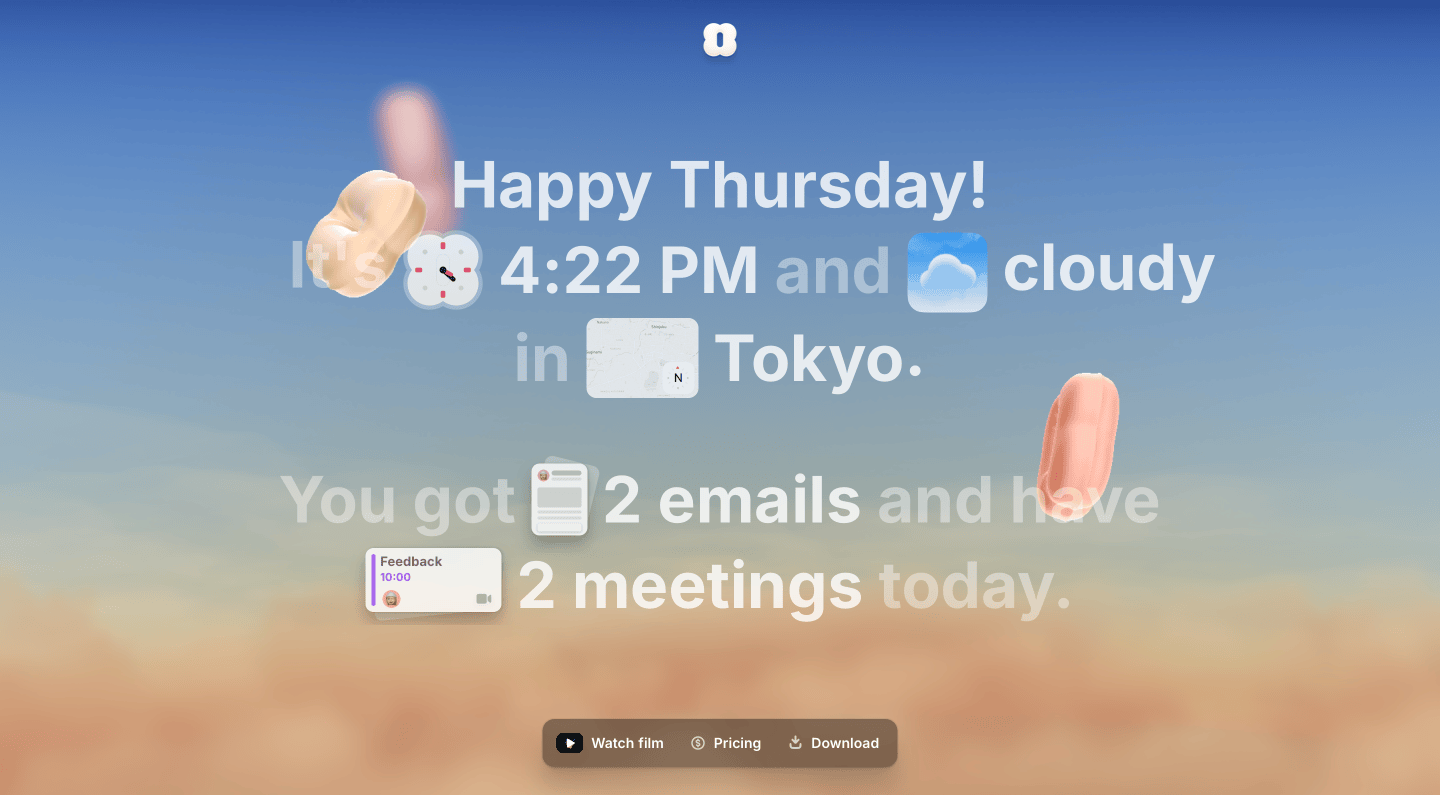
On the one hand, that seemed like the hook worked. I’m sure if they were bootstrapped, they could have found some success with their app. But they weren’t, so they had to go bigger. They pivoted to B2B and decided to ride the AI wave instead, going after the hot note-taking market.
The next iteration of their (far more austere) homepage then went with “Turn meeting notes into automated workflows.”
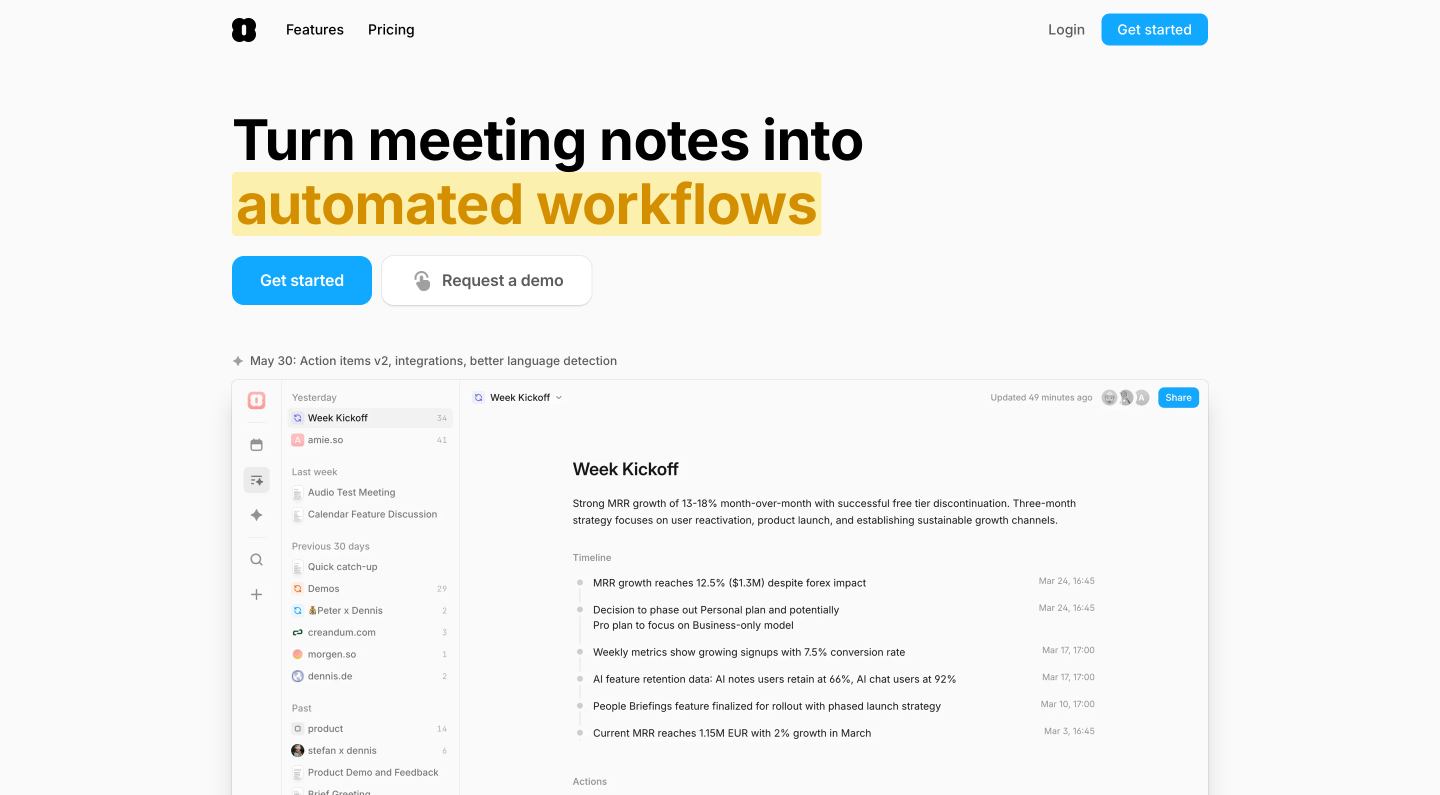
Two iterations, two very different hooks.
The old homepage was moved to their /art URL (which sums it up, but good on them for keeping it live) while their new one ditched… just about everything. No big animations. Minimal color. Minimal illustrations. Just copy + product screenshots. That’s B2B — words and product.
And credit to the team for pivoting — when you’ve raised VC and you’re looking for a home run, you should explore very different pivots if the first attempt doesn’t work. Insisting on the original vision is often vanity, not strategy.
But can you see how much is riding on that hook?
In B2B it’s your words and product that have to convey the meaning of your product and create that hook in the buyer’s mind.
Sometimes, in sales-led SaaS, the sellers have already worked out their hooks over hundreds of calls with prospects. Sometimes an easy place to start with positioning is making sure what marketing is saying in the ads and on your homepage is what prospects are hearing in discovery and demo calls!
Hook as concept
Every B2B tech company has a website, every website has a homepage, and every homepage has a hero section with a headline.
Given the visibility of that headline, it often attracts a lot of scrutiny (especially from yours truly if I’m roasting your homepage). But it also often provides a few clues about how a company thinks about itself and its strategy.
While a headline might be an obvious place to capture your hook (like Amie’s “Turn meeting notes into automated workflows”), I’m less interested here in the actual words used than the meaning you’re trying to express.
“Meaning” is pretty fuzzy though, I’ll admit. What I’m really trying to get down to here is your concept.
Billion dollar hooks
Let’s talk about your fundamental underlying concept and whether your positioning reflects that.
To make this more concrete, consider these billion-dollar hooks:
- Use cloud software not on-prem. (Salesforce’s “End of Software” campaign at the turn of the millennium, before either ‘the cloud’ or ‘SaaS’ had been coined.)
- Use chat not email. (Slack.)
- Use chat not forms. (Drift and “conversational marketing.”)
- Do ‘inbound’ marketing. (HubSpot, riding the digital marketing wave.)
- Use agile not waterfall. (Jira riding the agile wave.)
- Use Linear not Jira. (Linear riding a classic anti-incumbent wave.)
- Mine sales calls for insights. (Gong, riding the call recording wave.)
- Design collaboratively in the browser. (Figma.)
- Build your own workspace. (Notion.)
- Payments for developers. (Stripe.)
- Code with AI. (Cursor et al.)
Note that these aren’t necessarily headlines or taglines. You might never express it this bluntly to customers. Drift, for example, used “conversational marketing” to convey what you did with their chat tool in particular. That was their playbook, which was a core part of their brand (RIP) and a concept they could own relative to other chat providers.
These kinds of conceptual hooks are really what we’re digging for here, and the ones above turned out to be worth a billion dollars or more — sometimes much more.
This is particularly relevant in tech, too, because unlike much of the B2C world, we’re not selling a quick sugar hit or commodity staple. We’re selling the core ‘from/to’ transformation that your product enables.
Your turn
- What’s the transformation your product enables? What’s your ‘from/to’?
- If you had to express your hook like the ones above, how would you write it down?
- Have you written it down?
- Do sales and marketing use the same language?
Hook vs blob
What’s the opposite of a hook?
In the previous chapter, I mentioned those vague SaaS homepages we’ve all seen that say nothing and seem to inexplicably obscure what the product actually is or does
They’re just bad. But there’s another failure mode that I see a lot that’s more insidious because the team behind it think they’re good. They think they’re doing the right thing.
It’s the value blob.
Consider this example:
It’s time for total visibility over work execution, compliance verification, and the automation of legacy manual processes.
That’s a real example and a classic value blob. It’s three different value props rolled into one big blob.
Here’s the thing though — they all might be true.
It really might be time for ’total visibility over work execution.’ (Which does have specific meaning in its original context!) It might be time for the ‘automation of legacy manual processes’ for this particular industry.
But even if those things are true, that statement is not a hook. It’s neither catchy, coherent, or compelling. It’s just a blob.
And your humble author is no stranger to the value blob, either. My first positioning book, Positioning Playbook, was almost four times (!) the length of this book. That’s quite a blob! Sometimes, the more value you think you’re adding, the harder you’re making it for someone to catch any of it.
Imagine if I throw you a tennis ball. One is easy to catch. Now I throw two — ok, that’s getting trickier. Do you just try and catch one, or both? One in each hand? Too late, you missed. Now if I throw you three, what happens? It just gets harder. Your odds of catching any one ball actually go down the more I throw at you.
That’s a little counterintuitive. It’s easy to imagine that the more balls you throw to someone (or the more value props, features, or chapters, in my case), the higher the chances they’d catch at least one. But that’s not how it works, and marketers (including yours truly) often act as though if they keep throwing messages at you, one will stick. But it doesn’t work that way.
When it comes to your messaging, then, instead of a catchy hook, you’ve got a confusing blob that bounces right off.
Why does this happen?
For SaaS and AI companies, things aren’t always that clear. Perhaps your vision is a bit fuzzy, your ICP (ideal customer profile) is a bit of a mystery, or you don’t have any meaningful differentiation on a product or go-to-market level. In these cases, the temptation is to start adding generic value together. We’re easy to use! We’ll save you time! We have great customer support! All different kinds of industries can use our tool!
Maybe if we combine all these generic qualities, we’ll have a compelling hook?
I get it — you have to say something, but this is the path to the value blob, and the value blob is never greater than the sum of its parts. It never makes for a remarkable hook — “Oh, you’re easy to use and you’ll integrate seamlessly with my tools? Shut up and take my money!”
I’m sure every competitor in your category is saying the same thing.
Not that it doesn’t matter — things like integration obviously do matter as supporting value propositions. But you’ve still got to find that main hook. Without a strong hook you can’t sell, and if you can’t sell, you don’t have a business.
Super positioning & your hook
Positioning and messaging often go hand in hand, so much so that I often see folks talk about wanting to improve their positioningandmessaging, as though it’s one word and one concept. But there’s really two core questions here:
- Do you have a viable, coherent concept you’re bringing to market? Have you validated what’s in the jar, so to speak?
- Can your prospects read the label? Can you meet prospects where they’re at, with language they understand, in a way that speaks to their pains and gains? (No value blobs!)
This quest to engage with prospect attention touches everything you do — the uniqueness of your product, the market you choose, the sophistication and maturity of your GTM (go-to-market) machine… it all adds up to a simple hook that people outside the jar either get or they don’t.
It’s one of the simplest and hardest things to tackle as a startup or company. Prospects either get hooked and want to know more, choose you, and remember you, or they don’t and you don’t get their business.
That’s the stark reality we’re dealing with.
And I get how hard that is. I spent so much time over the last three years working towards this book because coming up with an original concept in a competitive space — and then finding a hook for it — is like pulling teeth. But this is just words on a page with me trying to grind it out, whereas most B2B tech businesses are juggling complex products, big customers, and relentless competition.
To win in that environment requires more than a degree of grit and intensity, sure, but effort for effort’s sake doesn’t matter if you can’t develop your core concept and build a meaningful position in the market. And that’s why I’ll be pushing you throughout this book to really think through your concept, vision, and narrative, for example.
They’re the ingredients that are unique to you that ultimately fuel your positioning. I can give you the system — the three prongs, three workshops, and four strategies we’re going to explore in the coming chapters — but you need to bring the core specifics.
Speaking of specifics, next let me introduce myself with some specifics on how I landed on super positioning!

Thanks for reading — let's chat! :)
Enjoying the book?
Buy on Amazon →