Find it & discover unique value in a niche
Find it in a nutshell:
- Goal: Find a way to be super useful to your audience.
- Strategy: Find your unique value by looking down for a specific segment to exploit, be that a vertical, job-to-be-done, user innovation, attribute, niche, or ‘best customer’ ICP.
- Attention: Active left-brain (looking down).
- Action: Find it — either do the analysis to find the niche yourself or do the work to see what your most innovative customers are doing.
- Position: Your tool or innovation is a revelation to a defined set of folks who really need it and very quickly get it.
You don’t have to deliberately build your positioning around a new wave to build an incredible B2B startup — we’re all riding the digital transformation wave after all. Sometimes, it’s about drilling down into (or stumbling across) a niche and building the right tool for the right people at the right time.
This is the world of more left-brain positioning by analysis — finding who you’re the best match for and then zeroing in on those best-fit customers.
But why do this? Why limit yourself to just one niche? Why not just sell to whoever wants to buy?
There’s some crucial logic at work here that comes from classic tech market strategy (tip o’ the hat again to Geoffrey Moore and Crossing the Chasm).
Niche momentum
Because you’re a small startup and no one knows who you are, you can’t afford to pay for every marketing touch for every sale you want to make. Instead, you need some degree of word of mouth, or at least reference-ability.
That is, you need people telling (or tweeting) other like-minded people about your great innovation. The only way they can do that is if they’re in the same proverbial room (industry, role, geographic location, Slack group, LinkedIn bubble, etc.) as the people you need them to talk to.
What’s more, when your go-to-market strategy relies on sales, and therefore reference customers, this niche approach is even more important. When company X comes to buy, and they see that company Y who is just like them is already a customer, they’re going to feel more confident taking a risk on buying you, especially if you’re a startup with mostly unproven or still rough-around-the-edges technology.
ICP as regression
Dave Kellogg has a very pithy way of putting this, saying:
While [your] ICP starts as an aspiration, over time it turns into a regression.
That is, you start out with some theories about who will get the most value out of your product, but after you’ve been in the market for some time, you need to go back and do the analysis to see who really gets the most out of your product.
That helps you refine your ICP (ideal customer profile), and therefore the way you position around, and sell to, them. This is explore/exploit, in other words.
This approach works best when you’re doing ‘segment & sell’ (as we discussed last chapter) because you now know who you need to go and sell to. Strategy is choice, and choosing your target customer to position around is one of the most important choices you can make.
Hand-held sales
One of the best founders to pull this off and document the process was Nathan Barry of ConvertKit.
Barry bootstrapped an email marketing startup in the face of overwhelming competition from Mailchimp et al. by being laser-focused on bloggers, doing direct outreach and sales to them, hand-holding them through migration, and picking off reference customers in each micro niche one at a time to build his startup brick by brick.
Eventually, the flywheel kicked in, word of mouth started to build, and the company now generates tens of millions of dollars in revenue every year, fully bootstrapped.
Vertical SaaS
At the venture-backed end of the SaaS spectrum, ‘vertical SaaS’ has become a popular strategy because it doubles down on this build-momentum-in-a-niche approach. However, the ’niche’ in this approach can often be an entire industry.
Famously, Veeva, who thought they would start in the pharmaceutical niche before moving on to a bigger niche, found it so profitable that they ended up building a public, ~$30B business in their original vertical and now position themselves as “The Industry Cloud for Life Sciences.”
Whether bootstrapped or venture-backed, the logic is the same. Position in a niche, sell only to a very specific kind of customer, get the flywheel going, and watch that compounding momentum drive your growth.
Proactive vs reactive
There are, broadly speaking, two ways to find your niche:
- Proactive — pick your niche/vertical upfront: You see a problem, build a tool, and take a very deliberate, founder-led sales approach to selling to (and onboarding) customers by hand, one by one, building with them as you grow. Alex Kracov, the founder of Dock, is another great example of someone doing this and documenting the process.
- Reactive — pick your best customers once in the market: Plenty of folks build something, start selling it, and are generally happy to sell to whoever’s buying. If this works, great, but in the long run, this can fail to generate that all-important niche momentum. The word-of-mouth fire never gets lit and growth never really takes off because your customers aren’t in the same ‘room.’ In this case, you need to analyze your customer base, find your best customers, and try to build momentum that way.
Some leadership teams will forensically analyze dozens of potential niches and adjacencies to see what segment appears the most attractive.
Others just YOLO it and follow their nose.
And others study their best customers. This approach is something that the queen of B2B positioning (and massive inspiration), April Dunford, strongly advocates. Even better, Dunford gives us a handy methodology for doing this kind of positioning, which we’ll touch on here.
(We’ll only touch on it because Dunford’s work is so popular and her efforts have been so tireless that there’s little point in rehashing it here. But again, let me emphasize how much I respect and admire everything Dunford has done, from the incredibly hard slog of trying to nail down a concise (!) methodology to the even harder slog of getting it out there through sheer force of will. A true legend of the marketing world!)
The second prong
This is where the second prong of super positioning comes into play — competitive positioning.
Here, we’re particularly interested in how you position your product closer to demand (customer value and jobs-to-be-done) and away from competitors (through uniqueness and differentiation), making your insane usefulness for a given segment clear in the process.
That’s why, in Dunford’s approach, for example, positioning starts with competitive alternatives and goes from there.
Starting with JTBD
Interestingly, Dunford’s approach to competitive alternatives is informed by the Jobs to be Done framework we discussed in the previous chapter, and we’ll explore some more here. As Dunford discussed on Lenny’s Podcast in 2024:
Eventually, Clayton Christensen solved this problem for me. I was reading everything I could get my hands on about the Jobs to Be Done (JTBD) theory, and I had the realization that the starting point had to be competitive alternatives. If it wasn’t, what we ended up with was positioning that sounded good in the office but didn’t work with customers because it wasn’t differentiated.
By competitive alternatives, Dunford means competing ways to do the job-to-be-done. That’s what she argues grounds positioning in the customer’s world.
That is, you’re not looking just to differentiate yourself from competitors over some new feature that customers may not know or understand, even though it might ‘sound good in the office.’ You’re differentiating yourself from the current or potential way a customer actually gets a job done, which might include manual processes, spreadsheets, general-purpose software, and so on.
That’s the measure of usefulness we care about.
So while Dunford’s positioning approach starts with competitive alternatives, we could also say it starts with the job-to-be-done. (Indeed, a lot of JTBD case studies look like positioning work to your humble author!)
That’s a very useful insight because it means we can bring all the JTBD literature to bear on our competitive positioning problems, especially when we’re trying to find unique value in a niche.
Everything in B2B boils down to a job-to-be-done in the end!
Emotion-driven positioning
We’re going to talk about tables and spreadsheets and analyzing jobs-to-be-done in a moment — all very left-brain laser-beam kinds of activities. But first, let’s note the role emotion plays in positioning. I don’t mean that in some gooey, how-I-feel-about-a-brand sense. I mean that in the sense of what pisses you off.
Dunford says positioning starts with competitive alternatives, and eagle-eyed readers will note that starting with competitive alternatives (category creation) is how I frame the cover of this book.
That is, I started from the job-to-be-done (find a dominant positioning strategy for startups), identified the existing alternative (“category creation”), and positioned against that. Why? It pissed me off!
The truth is, however, that the way I got there wasn’t through careful analysis; it was vibes. I was trying to find a hook because I was failing my own hook test. I wish I was analytical enough to figure that out ahead of time, but the reality is I was just noodling away until I felt like I had something strong enough to put on folks’ right-brain radars.
It turned out that the emotional energy of what annoyed me was a bigger driver for my competitive positioning than pure dispassionate analysis. Maybe that will be true for you, too.
After all, if you’re going to spend a lot of energy trying to build a position in the collective mind of the market, that energy has to come from somewhere, and an emotional driver is as good as any!
Pain = motivator
This position-against-things-that-piss-you-off approach seemed to be at least a little bit true for Dunford, as well.
Dunford’s competitive foil was the classic positioning statement. You know the one, the madlibs style “We’re an X for Y, and unlike Z, we offer A, B, and C.”
Dunford really, really, hates those. On her site she writes how they “suck”, how they’re “a candidate for most useless business tool ever,” and how they’re “harmful” and you “should never do one.”
That’s some emotion-driven energy! I love it.
Pain is life’s great motivator, and frustration at how everyone is Doing It Wrong is one big motivating pain.
What pisses you off about the way things are currently done in your industry or market?
Outsized ICP value
Pain aside, the alternative to the positioning statement is, for Dunford (and I’m brutally simplifying here), a methodology and a table for analysis.
To paraphrase the methodology:
- First, we identify competitive alternatives (in the jobs-to-be-done sense, i.e., status quo alternatives, not just peer competitors).
- We then identify what makes you unique, in comparison, in terms of features, benefits, and the value you offer, and roll those into value themes.
- Finally, we figure out who cares a lot about that value, i.e., your best customers.
And then we try to sell just to those people.
That is, you calibrate what makes you unique (differentiation) relative to all alternate options with what makes you most valuable (demand) for a specific set of customers, and you build your ideal customer profile (ICP) where those things intersect.
Or, if I can simplify further, we might look for existing customers where:
- Your differentiation + their specific demand = insane ICP usefulness.
That’s how you win deals over alternatives.
“Oh, you have this specific need? Well, we have this specific solution that creates this specific outsized value just for you.”
Or, if ICP value is similar, your ‘best customers’ might be those who pay you the most, or require the least support, too. Either way, you drive go-to-market (GTM) efficiency by making sales easier, more profitable, or both.
Write. It. Down.
How do you apply this to your situation? Time to crack open another spreadsheet or doc and start writing stuff down!
You can call this a one-pager, canvas, table, spreadsheet, whatever. Even if you choose my preferred narrative approach (chapter 9), the point is to make sure you actually write your positioning down.
That is, there’s no super-secret special sauce in any particular template. The point is to get writing and do the actual analysis.
Get listing
This might seem obvious to marketers — we tend to be the writers, after all — but you’d be amazed at the number of sales-driven orgs where the culture is far more verbal, and they can go for years without ever really writing their positioning or ICP down in a concrete way.
But write what down? Dunford’s approach is, as mentioned, to list your features, describe their benefits, list the customer value of those benefits, and then group your value themes together.
This approach is great when:
- You want to rigorously define why you’re better than the status quo (manual processes, spreadsheets, etc).
- You want to rigorously define why you’re better than peer competitors.
This is an approach born out of competitive positioning in enterprise sales in particular. That’s where the customer’s laser beam really comes out and they’ll go over your features, why you’re different, and why they should care, in forensic detail.
Your JTBD canvas
Personally, I like to go a bit further and come back to Jobs to be Done.
Over the years, I’ve seen a bunch of frameworks put together by consultants where, if you rip the mask off Scooby-Doo style, underneath you’ll find it was Jobs to be Done all along.
And I would’ve gotten away with it, too, if it weren’t for you meddling kids!
(Tongue is firmly in cheek here, and I say that about myself as much as anyone. Obviously, people bringing their own experience and perspective to the theory has value, and hopefully that goes for this book, too.)
If Jobs is where it starts, I find it helps to go back to the OG of JTBD, Tony Ulwick, and go from there. I like to riff on his definition of Jobs, which I paraphrase as:
- Customers have needs; those needs are a function of jobs they want to get done.
- Jobs are stable over time, solution agnostic, and ideally expressed in a brief statement.
- Customers buy products to help them get their jobs done, ideally on one platform.
- Customers can express on what dimensions they’d like to improve how they do those jobs — faster, cheaper, more often, less often, and so on.
Your turn
With that definition in mind, I strongly encourage you to make your own spreadsheet or table to think through how this applies in your case, listing out:
- Role: The customer or role, i.e., the person doing the job.
- Job: A given job they want to get done (don’t assume the solution here, keep it focused on the problem).
- Status quo: How they currently solve it.
- Features: Your feature/s that help get that job done.
- Outcomes: The dimensions of improvement your features enable in a very quantifiable way.
- Differentiators: How your approach compares to the competition.
- So that: The big picture outcomes that are less quantifiable but are the big emotional payoff — get your day back, stress less, feel in control, feel in command, be dramatically more productive, and so on.
The accuracy of your version of this table — and the insight it contains — is a function of your ability to look down into your customers’ lives.
And not just what you’ve seen personally, but what your entire company has seen in terms of case studies, outcomes, customer research, product development, and so on. Everything you do as a company, in a sense, is working towards that outcome of a job solved in a particular, differentiated way that makes you unique.
Sugar-coated broccoli
Having the language of Jobs (along with features, benefits, and outcomes, for example) is very helpful — we need universal ways to describe needs and outcomes — but sometimes the real positioning value is using JTBD to find message/market fit for your startup.
Let’s say you’re a very horizontal tool like Notion, for example, with a big, whole-new-way-to-work pitch. But is that why they sign up and buy?
Here, it pays to be laser-focused on the jobs people are actually getting done with your platform, and to reflect that language back to prospects so they get it. They simply won’t know or care otherwise — I mean, how could they?
Before their AI push, for example, Notion’s homepage did this very directly by highlighting three main areas — wiki, docs, and projects.
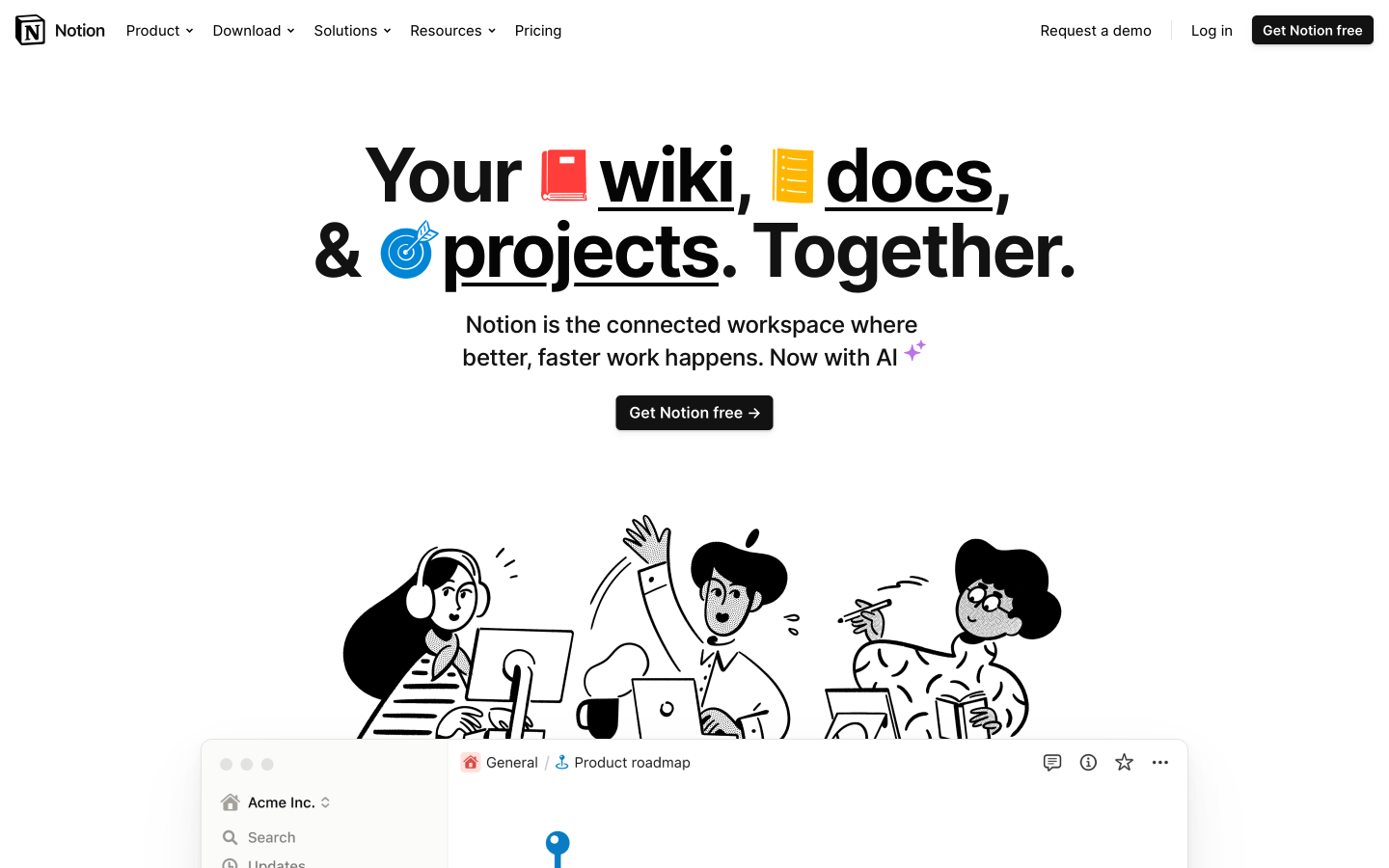
Call them use cases, call them jobs, call them whatever you like, the point is that the language matched how prospects thought about the actual tools they needed.
Contrast that with Notion’s big right-brain vision, which was, according to founder Ivan Zhao in an interview on Lenny’s Podcast, that “everybody can create their own software.”
The problem was that nobody cared.
Notion tried, in the early days, to let people build with the tool, but they just didn’t care. So instead, they said (edited for clarity):
“Let’s hide our vision (which is that everybody can create their own software) in the form factor that people do care about. What kind of tool do people use every day? Productivity software. […]
“The world is not like you. The world [does not have a] developer or designer’s mind. The world only cares about what’s in front of them.”
So they hide their vision instead:
We call it sugar-coated broccoli. People don’t want to eat the broccoli, but people like sugar, so give them the sugar and then hide the broccoli inside of it.
That’s a great turn of phrase, and the net result is putting the jobs people actually want to get done front and center.
I like to think of it as message/market fit, and of course it goes deeper than just the literal message in your homepage hero, it goes to how you frame your product, the templates and integrations you offer, the case studies you highlight, and so on. But it ultimately matches what’s “in front of” the user, and that’s their jobs-to-be-done.
Differentiation vs. fit
When we talk about competitive positioning, most of the time that means highlighting your differentiation — how you’re unique relative to the competition. That’s because most B2B tech products and platforms, especially in SaaS, are, let’s face it, pretty same-y.
But let’s remember our definition of positioning — it’s the act of being as far from your competitors as possible while being as close to your customers as possible.
Notion’s problem, initially, was that their distance from their competitors was also their distance from customers, and that doesn’t work. In that sense, Notion was too unique, too ‘out there’ relative to what customers wanted in their day-to-day. They had the differentiation, but they didn’t have the fit.
With a combination of right and left-brain attention, however, we get both the big vision and unique product and the focused specifics that people care about in the day-to-day.
That requires the kind of intense left-brain focus we’re interested in here — focusing down the y-axis on the actual jobs-to-be-done people can achieve with your product, and the language they use to describe those jobs.
For Notion, this focus — and all the templates that followed — helped propel them into becoming the juggernaut they are today.
Honestly, I’ve seen the concept of Jobs to be Done blow teams’ minds — it finally gives them the language to articulate the needs they’ve been selling against and building for over all these years.
We understand the world through metaphor, and ’the job to be done’ is a very powerful metaphor in tech.
The L in R/L/R
There are limitations to this approach, especially when it comes to your initial positioning. You still need a big idea to put on folks’ radar in the first place and that’s not always found at the bottom of a spreadsheet.
When analysis (which is always backward looking) is your dominant mode of how you do positioning, there’s often a bit of handwaving about your initial positioning. You ‘just’ put your product out there, see who buys it, and then figure out who your best customers are.
But that initial net you’re casting still determines who the ‘best’ customers are that you can pick from. There’s a lot riding on that initial positioning!
For example, In a 2024 podcast interview with Brian Rhea, Dunford said:
The best time to actually look at your positioning and think about tightening it up is when you have actually been in the market for some time and you have got some traction, to the point where you can start seeing the patterns in, “These are the sorts of people that love us. And this is why.” […]
So, you’re fine to go out to market with your positioning theory but be prepared that, in almost every case, the positioning ends up changing as you start getting more experience with that market and you see what works and what doesn’t.
In fact, most of the time I counsel early-stage startups to keep their positioning a little bit loose for that reason. Because you actually want to get exposure to a wide swath of customers, so that you can then figure out, “Well, who really loves my stuff, and why?”
This is, of course, all very sensible advice for once you have got some traction and want to know where to double down. It’s also very true that early-stage startups pivot and reposition all the time, so you shouldn’t get too wedded to your initial approach. Nor should you try and predict everything upfront, which is a recipe for overthinking and second-guessing yourself. (Not that your humble author would know…)
You need to keep sampling reality — customer reality — and learn as you go. It’s action, not endless speculating, that ultimately generates the information you need.
But, again, how do you get that initial traction, and what kind of traction is it?
You have to be thinking hard about what you’re putting on folks’ right-brain radar before you get out the laser beam and start doing the analysis. Indeed, your initial idea has to be strong enough to create some signal you can find through this left-brain analysis.
You ideally want to be spoiled for choice when it comes to finding your best customers, not scratching around trying to find some kind of hook from a bunch of so-so deals, and this can throw folks off.
Obvious vs. fuzzy
Initial positioning aside, what are you actually looking for when it comes time to deploy your left-brain laser beam? What are you hoping to find in the middle of this R/L/R jump?
Here, simply knowing what to look for can go a long way, especially when a niche positioning opportunity slaps you in the face.
This is especially true when you see what unexpected and innovative things customers do with your product, essentially finding your niche position for you. (Which, again, isn’t necessarily found in a spreadsheet of features and imagined outcomes.)
Other times, however, it’s more fuzzy, and a niche isn’t so clear-cut, and you instead need to camp out on a specific attribute in the face of intense market competition.
Let’s touch on both.
Obvious — user innovators
If you’re trying to find a new positioning opportunity, one of the best questions to ask is “Are any of our users doing something cool (or crazy) with our product?”
Sometimes, very obvious positioning opportunities present themselves when the current way just isn’t working. Perhaps you’re fortunate enough to spot a handful of users — or even just one — doing something innovative with your product, and the positioning lightbulb goes off.
That was true for Loom, the video recording software, as we’ll see in our examples below.
This is the world of user innovation, and it’s gold for positioning. Why? Well, it turns out R&D is very expensive for startups and companies alike because trial and error is very slow. A startup might build a product and take a shot at positioning it, but from their point of view, that’s just based on the trial and error they could do internally. And that might not be much!
Therefore, if we think from first principles in terms of vision, the opportunities for a product a startup can see, in a very literal sense, are inherently limited. There are only so many eyes doing the looking.
But if you put that product in the hands of dozens, hundreds, or thousands of customers, suddenly you have an infinitely faster R&D trial-and-error flywheel, at least in terms of uncovering good-fit jobs-to-be-done. There’s just much more ’looking’ going on.
This makes it a very powerful tool — you’re selecting the best uses of your product from many trials, but also the least reproducible because, other than making sure you’re keeping an eye out for novel uses, it’s dependent on what your user innovators come up with.
There has to be some value there to begin with for people to adopt the product, but even companies like Apple with their we-know-what’s-best culture rely on this approach to find the best use cases for their products like Apple Watch (notifications and health tracking) and Apple Vision Pro (movies and virtual screens for your Mac).
This phenomenon of user innovators has been studied for decades by Professor Eric von Hippel. It’s amazing what research has established that we occasionally rediscover in tech (which, for me, came via Professor Ethan Mollick, one of the most prominent voices in AI.)
This kind of user innovation can be an absolute no-brainer to go after, especially if your initial positioning flops hard. But you have to do the work to find it. By definition, these are edge cases that you have to tease out through interviews and analysis, and just by being very receptive to customers doing weird things.
But if whatever you’re doing now isn’t working, why not try and find what is amongst the people who are already using your product?
Fuzzy — unique attributes
Sometimes things are working, or working well enough that you don’t want to risk a massive pivot to something else, but you know your positioning could be tighter.
Here, especially in competitive markets, positioning opportunities might not be hit-you-in-the-face-obvious, but you can still find an attribute to position around, something to be ‘more about’ than the competition, and if that keeps you competitive in a growing market, you can grow with the market.
A client of mine spotted a glaring gap in a customer workflow while on-site with the customer and built automation functionality to close that gap. That gave them an attribute — automation — to be ‘more about.’ That gave them an angle to be super useful and position around, as we’ll explore below.
Positioning and gestalt
I describe this as “fuzzy” positioning but what I really mean is we’re looking for a gestalt, which is a German word for “an organized whole that is perceived as more than the sum of its parts.”
It’s about a unique configuration that’s driven by positioning-by-attribute. It’s inherently more varied simply because there are many attributes you can be ‘more about’ than the competition, and the gestalt you create is unique to you.
If you pick your attributes wisely, however, you can find a compounding position and carve out a unique space both in your market and the customer’s mind, perhaps through positioning around:
- Price & segment: That is, targeting the low or high end of the market. (Workbooks in CRM, which positions itself against Salesforce’s pricing with lines like “No sales tactics. No overpricing. No bullsh*t.”)
- Point of view & UX: A specific point-of-view on the market, perhaps with a UX to match. (Linear, as we’ll see next chapter.)
- Wedge attributes: Usually thanks to feature areas they’ve invested in, especially when leaning hard into a point of view, perhaps around automation, collaboration, intelligence, and so on, or just doing a specific JTBD 10x better. (Spellbook, as we saw in the previous chapter.)
- Niche category: A narrow sub-category they’ve created — for instance, they’re a particular kind of CRM or database, one for product-led sales (Pocus). They’re not creating an all-new category — everyone knows it’s still a CRM or a database — but they’ve found a new, innovative niche and a fresh way to map the parent category.
- Competitor contrast: Sometimes you can call out an incumbent directly, for example, Fathom Analytics calls itself “A Google Analytics alternative that’s simple & privacy-first.” (Note their privacy-first attribute comes from a bit of wave riding, too, specifically the GDPR legislation & resulting need for compliance!)
The point of a gestalt is to roll these together in a compelling way.
Maybe you’re the cheaper version of an incumbent with a better UI derived from a specific point of view about how to do a specific job or complete a workflow.
Or maybe you’re the developer-focused product analytics platform PostHog, with a homepage that’s as thorough as it is unhinged, featuring, among other things, an illustrated section with their cute mascot in a Godzilla costume terrorizing a city and a boxed-software call-to-action helpfully framed with a giant header that says “This is the call to action.”

But PostHog also competes aggressively on price, claiming to have the “lowest pricing for every product” and to be “always cheaper than the cheapest major competitor.”
That’s a unique combination of attributes!
Again, building a super position is about compounding specifics — the unique aspects of your product and company that make you, you.
Refining vs. reinventing
One of the things that took me a long time to understand about positioning in the Obviously Awesome sense was that the success stories — ones where a company seemed to reverse their fortunes through positioning alone — tended to be the rare cases where an obvious user innovation was discovered.
That was in contrast to some of the fuzzier “point of view” positioning which seemed more about refining rather than reinventing your positioning.
What’s appropriate for you depends on your trajectory and goals.
The Browser Company, who made the Arc browser, for example, found a niche with power users who loved the product. They’d found their ‘best customers,’ in a sense — a passionate and vocal group who loved the product. But The Browser Company had raised $128M and aspired to something bigger.
Despite, as they wrote in a newsletter, the fact that a “lot of people loved Arc,” the reality was that “for most people, Arc was simply too different, with too many new things to learn, for too little reward.” It was more like a “highly specialized professional tool (like a video editor) than a mass-market consumer product, which we aspired to be closer to.”
So they went back to the drawing board, released Dia, a new, AI-first take on the browser, and tried to ride the AI wave to create, in their words, “the successor to the web browser” and “have an impact for people at real scale.”
That is, they went back to that first R in the R/L/R jump and rethought what they were putting on folks’ radars to begin with.
That’s a massive reinvention.
If they were just an indie product, however, then refinement would have made sense. They could have doubled down on the power-user positioning and dined out on that, refining their positioning based on who loves them and why.
But that wasn’t their ambition, and if you’re a venture-backed startup, your positioning ultimately has to be a function of your ambition, which that requires a lot of focus on the first R in the R/L/R jump.
(And in The Browser Company’s case, resulted in a $610 million acquisition by Atlassian. TBC didn’t end up building a super position, but their ambition means they successfully exited to help Atlassian maintain theirs!)
Positioning failure
Going after a niche is common advice for a reason. There’s a certain relief and freedom in not trying to compete with everyone over everything — but it takes a lot of discipline to get it right and avoid common failure states. Let’s run through a few of them.
Not actually niching
Some folks do positioning exercises, feel good about it, and then… not much happens. That’s because they didn’t drill down hard enough to focus on a niche (and particular problem) where they could innovate and generate that all-important momentum.
That is, they didn’t actually choose a meaningful position; they just kept drifting along with a slight tweak here or there or a lightly refreshed homepage.
Remember, as much as I love strategic messaging, copy tweaks rarely move the needle on their own. Positioning requires going back to the strategic specifics that are unique to you.
Not getting out of your niche
You sell to early adopters, and they love it. Great! Then you try to cross over to the mainstream (per Crossing the Chasm) and discover there is indeed a chasm there waiting to gobble you up. Not so great! OG smartwatch maker Pebble had the misfortune of experiencing this first-hand in the mid-2010s. They made a watch for nerds distributed to nerds through crowdfunding, tried to go after the mainstream market instead, but the product flopped, and they went bankrupt in 2016. (Pebble’s founder managed to revive the tech and brand in 2025, however!) Breaking out of an early-adopter niche can be brutal.
Staying too niche
But break out of that initial niche you must, and, eventually, contra the saying, you kind of can be all things to all people, or at least more things to more people. That’s ‘how brands grow’ (to borrow a phrase, as we’ll look at next chapter), and it’s why Salesforce, the granddaddy of SaaS, isn’t a plucky PLG app anymore but a giant suite of products and sub-brands. If you stay in your niche forever, the world might pass you by. And ConvertKit, for example, is now riding the ‘creator economy’ wave — even as a bootstrapped company, they didn’t stay niche forever.
This is where competitive positioning and the art of more right-brain strategy intersect. You’ve got to know where you are in terms of your growth and market penetration. Positioning evolves over time, and this is where your own right-brain and left-brain attention comes into play.
Your right-brain radar attention is great for studying your own change-over-time narrative, how the market is unfolding, and how you’re making progress toward your greater vision, as we saw in the previous chapter.
Meanwhile, your left-brain laser-beam attention is great for looking down at where your competitive positioning needs to be today, right now, for the buyers who want to buy today and not in six months or a year from now (as April Dunford often says).
When these two modes of attention come together and result in a memory association that sticks, you create a super position. And those positions are often found, hence this strategy of finding it.
Niche positioning — examples
Let’s wrap up this chapter with some examples, starting with Qualtrics, whom we touched on when discussing wave riding, and then Loom and my LMS client.
Qualtrics — niche ICP
Qualtrics has been sold and acquired a couple of times for billions of dollars, but the truth is they bootstrapped for much of their existence, initially selling just to marketing professors because one of the founders, Scott Smith, was a marketing professor, and they couldn’t sell to anyone else! When we talk about getting close to an ICP, that’s what it can look like — being super useful for one incredibly narrow role.
But that worked, and eventually, they could sell to business schools, then universities, then finally the mainstream corporate market, in true niche to reach fashion of expanding concentric circles.
Loom — user innovation
Loom, the async video software service, originally started as a user testing platform, where their customers could record user tests. But then the team noticed one user doing something unexpected — they recorded a short video of themselves explaining the results of a test to share with their team.
Aha — collaborative async video! That turned out to be super useful, so the team pivoted, positioned around async video with almost flawless product execution to get them going, and was eventually acquired by Atlassian for just shy of $1B.
Spotting one innovative user can have a profound impact on a startup’s trajectory!
LMS provider — owned attribute
As mentioned, I helped a past client of mine clarify their positioning around automation. They, along with hundreds of other companies, were in the highly competitive LMS (Learning Management System) space. Other companies positioned around micro-learning, AI-powered learning, collaborative learning, and more.
Ultimately, my client was acquired by one of their well-funded competitors. Most startup exits are acquisitions, and having a clear attribute you ‘own’ (and have built out) can help make your value clear to both current prospects and future acquirers.
vSaaS
As we discussed earlier in the chapter, there’s also the world of vertical SaaS where, like Veeva, you position exclusively in one industry.
For example, construction management SaaS Procore carved out a ~$10B market cap in the construction industry, and restaurant management platform Toast, despite a rocky few years, is worth ~$26B. Much has been written on vertical SaaS over the years, particularly by investors who obviously find those sorts of outcomes rather attractive.
Next, we’ll look at our third strategy, own it.
Your turn — what’s your unique value?
- What pisses you off about the way things are currently done in your niche or industry?
- What unique value have you found in the segment you’re targeting? How strong is your vision in terms of being able to look down into the workflows and struggles of the folks in that segment?
- How did you originally see your unique value? Was it through your own lived experience, observation of your customers’ problems (like my LMS client who was on-site with a customer), or observation of your customers’ innovations (like Loom and video sharing)?
- What niche (if any) are you targeting in terms of a particular role or vertical? Has that made sales easier? Could it make sales easier?
- What attribute (if any) are you trying to own so you can be ‘more about’ something than your competitors and build a unique gestalt?
- What role does your unique value play in your current sales narrative or messaging? If you surveyed customers, would they agree that’s why they bought you?

Thanks for reading — let's chat! :)

Enjoying the book?
Buy on Amazon →