Combine it & build a super position
Combine it in a nutshell:
- Goal: Find a way to combine being relevant, useful, and memorable so you are known, chosen, and remembered.
- Strategy: Once you’ve found a winning super position, ride it to be #1 in your niche, then your market, then your adjacencies.
- Attention: A combination of right and left-brain attention, with brand building to boot.
- Action: Combine it — keep your eye on the prize and sequence your positioning as you go from niche to reach.
- Position: A compounding stack of riding it, finding it, and owning it.
The last of our four super positioning strategies is, essentially, “hold on tight.” If you’ve found a winning super position, where some or all of our core positioning ingredients come together, there’s still a mountain to climb, but the good news is you have the mountain to climb.
Lots of folks, however, get caught up on the next deal, the next release, and the next funding round without stopping to think about the hill they’re trying to climb, what truly winning their segment or their market would plausibly look like, and how they can position themselves to get there.
To be fair, some folks don’t have to. If you’ve managed to tap some rich vein of demand and you’re being inundated with customers, there’s no need to worry about building momentum through niche positioning — the momentum is already there. You might think about what comes next, of course, and be deliberate in how you position in new adjacent niches as you grow — there’s always the next level to reach and the next boss to beat — but when you’re on this trajectory, it’s really just up to you to not snatch defeat from the jaws of victory.
But if you haven’t stumbled across that pot of demand gold, it can be a highly useful exercise to think through what, exactly, your vision is for the winning super position you’ll build for your company, with your product, in your market.
What does your winning super position look like?
Consider making a checklist of steps that would help you identify when you’re on the right track, even if it’s just the basics, for example:
- You’ve clearly identified the goals you need to achieve relative to your ambition and funding.
- You’ve planned a reasonable positioning experiment to create the necessary momentum to reach those goals.
- You’re getting an appropriately positive reaction in demos and sales calls — people are genuinely lighting up and wanting more and not just giving you the polite “Oh wow, sounds great, yeah, uhh, we’ll definitely get back to you on that, just let me have a think about it” (i.e., no, thank you).
From there, it’s a matter of what makes sense for your GTM motion.
Sales folks can ‘segment & sell’ with a narrow focus in a niche to build momentum while product-led growth practitioners may go for ‘cast & catch’ with a broader pitch for an entire discipline (like product design, marketing, or general productivity and team collaboration) in a much more horizontal fashion.
Either way, your positioning, ambition, and go-to-market strategy all need to work hand-in-hand.
Figma’s super position
A super position is where a strong change narrative meets a laser focus on the actual tool, while building an incredible brand in the process.
On the PLG end, Figma, for example, did this extraordinarily well. They managed to:
- Ride it: They managed to be super relevant by riding the rise of digital product teams, design systems, and the “Design Systems Manager,” studying how modern product teams work so they could prove their value.
- Find it: They managed to be super useful by having an extreme laser focus on their product and technology, zeroing in on the appropriate use case for their WebGL-powered tech, which competitors simply couldn’t copy.
- Own it: They managed to be super memorable thanks to the collaborative, multiplayer nature of the tool that often drew in the entire org (network effects ahoy), exposing everyone to the brand and Figma experience.
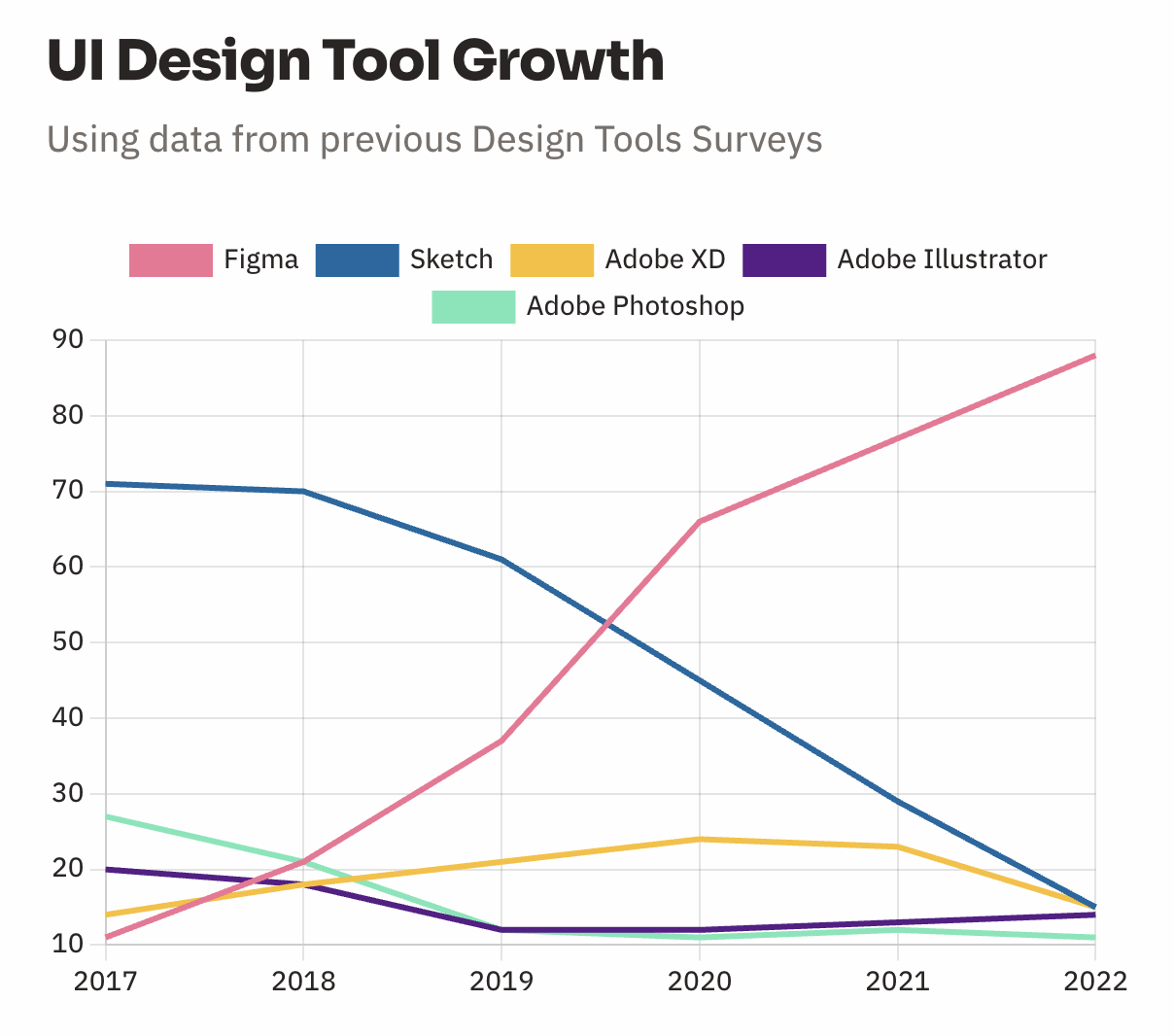
- Combine it: They found a winning super position, one that ultimately had Adobe licking their lips in anticipation of acquiring them for $20B, which didn’t work out, so they went public instead, and now have a market cap of ~$26B.
Figma’s complete dominance of their category was something to behold, perhaps as best summed up in the chart below from UX tools.
And to be fair to Figma, they did a lot of analysis and strategy work to pull that off. In an interview with Connie Yang on the Distributed Podcast, Figma CEO Dylan Field said (edited for clarity):
There was a point where we had to say we’re going to focus on interface design […] We used a cool framework — omit, raise, reduce, create — from Blue Ocean Strategy to figure out, okay, what are we doing that’s different than the competition? What are we not doing that the competition is doing? What are we doing worse and where are we going to make this brand new?
Props to their use of the Blue Ocean Strategy framework there!
Qualtrics’ winning position
On the sales-led and enterprise side, it’s worth returning to Qualtrics, which we’ve touched on a few times because they’re also a fantastic example of making these strategic positioning choices over the lifetime of the company, which was founded back in 2002. Specifically:
- Find it: Qualtrics started as a useful survey product, originally selling to marketing professors in business schools because that was the background of one of the founders.
- Ride it: 15 years (!) into their journey, Qualtrics managed to generate insane relevance for a survey platform through their concept/category — “experience management.” The brief wasn’t to create a literal new category of survey software; it was to transcend the survey software category entirely with a new concept they could put on the right-brain radar of C-suite prospects. The wave they identified was the “experience economy,” and they aimed to prove their value with their experience management, or “XM” playbook. (And they could prove it because they had 15 years of experience under their belt.)
- Own it: They went all-in on “XM” as a brand (going so far as to make XM their stock ticker, echoing Salesforce’s CRM ticker). XM is in their logo; it’s how they organize their product lines (“XM for customer experience,” “XM for employee experience,” etc.); it’s the theme for their events and content marketing, it’s everywhere. That’s what it takes to make your brand super memorable (at least in the world of enterprise SaaS!).
All told, it’s an incredibly strong super position that hammers home their owned message and position across every touch point. But it took years to build, and it was initially a lonely time trying to make it happen.
This took Qualtrics to an IPO and subsequent acquisitions — acquisitions that were predicated, in part, on the strength of their ‘category creation’ efforts.
It also drove their main competitor, SurveyMonkey, bananas. They tried to rebrand as “Momentive” to chase the enterprise and the “experience management” concept Qualtrics pioneered, only to revert back to SurveyMonkey two years later.
Evolving your brand to set the pace and completely rebranding to chase a leader are two very different strategies with very different results. High-stakes rebranding is a fraught business — it’s not a positioning experiment I’d recommend.
In this case, Qualtrics evolved their brand to build incredibly tight memory associations between their name and XM.
SurveyMonkey’s attempt to try and build a new brand from scratch that could also be associated with experience management was, in comparison, always a doomed mission. Especially because “experience management” was never a real generic category of software they could compete in — it was always an extension of the Qualtrics brand. SurveyMonkey could never ‘own it’ like they did.
Winning positions are unique
Qualtrics is an interesting example of the fundamentals of super positioning, but I’m not describing it here as a template every enterprise-focused B2B SaaS company must follow.
Instead, I include it to highlight how many things need to go right.
And that’s going to be true for you, too. Winning positions are ultimately unique because waves of technology (i.e. what you can ride) and emergent opportunity (i.e. what you can find) are unique.
Clay, as we saw in the last chapter, is on the way to building a super position precisely because they saw things that were unique to them — the outbound enrichment opportunity, the wave of AI research agents, the “GTM engineering” concept, and, of course, their data-sculpting spreadsheet-and-APIs product.
An insane number of things have to go right as you ride a wave, find a niche, own a memory, and combine it into a super position, but the result will be unique to you — all great business positions are.
Great businesses ‘compete to be unique,’ to borrow the line from Michael Porter that sums up just about every popular business book that has been released since. It’s not easy — it’s brutally hard! — but we’re insanely lucky to be able to participate in this crazy world of tech and startups at all.
Complexity from simplicity
In the world of tech and venture-backed startups, this is what we’re trying to do — we’re trying to build truly great, insanely unique businesses. That requires a great deal of vision from you as a marketer, GTM leader, or founder, both into what is and what could be.
But these big winners aren’t born with this level of strategic complexity, however. Instead, by necessity they start from something small that works, and while I’m throwing ideas at you, dear reader, I’m really just hoping there’s one idea that clicks.
Again, the point is to find a simple system that works to build on, per Gall’s law:
A complex system that works is invariably found to have evolved from a simple system that worked. A complex system designed from scratch never works and cannot be patched up to make it work. You have to start over with a working simple system.
When discussing successful businesses, there’s always the risk of looking at famous companies and repeating the “How to draw an owl” meme, where there’s mountains of context missing between where they started (a couple of rough circles) and where they finished (a beautifully detailed hand-drawn owl).
But in the spirit of keeping things simple, let’s think back to where we started, with hooks and catchy ideas.
Hook as super position
These were the hooks we ran through in chapter 3, for example:
- Use cloud software not on-prem. (Salesforce’s “End of Software” campaign at the turn of the millennium, before either ‘the cloud’ or ‘SaaS’ had been coined.)
- Use chat not email. (Slack.)
- Use chat not forms. (Drift and “conversational marketing.”)
- Do ‘inbound’ marketing. (HubSpot, riding the digital marketing wave.)
- Use agile not waterfall. (Jira riding the agile wave.)
- Use Linear not Jira. (Linear riding a classic anti-incumbent wave.)
- Mine sales calls for insights. (Gong, riding the call recording wave.)
- Design collaboratively in the browser. (Figma.)
- Build your own workspace. (Notion.)
- Payments for developers. (Stripe.)
- Code with AI. (Cursor et al.)
But these weren’t just hooks.
Ultimately, they turned out to be super positions.
And while the products and businesses built around these positions are very complex, the core idea — and the position built in the mind of the buyer, either explicitly or implicitly — is often very simple.
One way to keep it simple is to come back to this basic question: How are you helping your customers succeed?
Answering that question — articulating your theory of customer success and finding your hook — can help bring you back to that simple system that works that a complex system can evolve from.
Down to you
It requires someone to do the looking, so to speak. And now we know how the underlying fundamentals of attention work (including your vision) and how they manifest in B2B positioning, I hope you can be the one that sees that new theory of success, that hook, and, ultimately, that super position.
I mean, if not you, who else? At the end of the day, it’s up to you and the vision of your company to look out on the right-brain radar and down with your left-brain laser beam, and bring that all together in a memorable brand association. That’s the super position we’re shooting for.
That’s always difficult, always fraught, and always involves scratching around to get started. But knowing how positioning fundamentally works — along with the hook in the buyer’s mind you’re gunning for — at least, I hope, helps you know what to look for.
Likewise, I hope that, in some small way, the four positioning strategies we’ve discussed — ride it, find it, own it, and in this chapter, combine it — have also given you a better sense of what it is you’re looking for so you too can build a truly unique product, company, and position in the mind of the buyer.
Let’s wrap this up with a few final questions to ponder and then I’ll wrap up the book with the super positioning manifesto next.
Creating your super position
- What’s your current vision for the winning super position you want to achieve in your market?
- What choices will you make to get there, especially in terms of proving value on a wave, finding it in a niche, or owning it as a brand?
- How can you stack your advantages across the wave you’re riding, the technology you’re developing, and the brand you’re building, like Figma did, for example?
- Or, how can you sequence your growth, going from niche to reach to brand, like Qualtrics did?
- And ultimately, what’s unique to you and the story you can tell, as you compete to be unique?

Thanks for reading — let's chat! :)
Enjoying the book?
Buy on Amazon →