Super relevant, useful, & memorable
Welcome! I’m Luke, your humble author.
You are, I’m guessing, someone who wants help positioning and pitching their startup.
In this book, I’ll teach you how to do both at a strategic level based on a breakthrough in our understanding of attention — a breakthrough that’s been almost entirely unexplored in B2B until now.
(Which is kind of funny when, on the GTM side of things at least, engaging people’s attention is the whole gig. And this discovery has just been sitting right there!)
We’re also going to take the positioning lessons from the SaaS era and, in light of this new understanding of attention, package them up into simple guides and strategies you can use in this new AI era and beyond.
Narrative is, both figuratively and literally, at the heart of this book, and I’m incredibly excited to see how the ideas we’re going to cover help you shape your story for this new era.
The pendulum has swung from the mature phase of the B2B SaaS market back to the greenfield world of AI where narrative reigns supreme and buyers are shopping for possibilities as much as they are for product.
Generational opportunity abounds, and this book will show you how to start building towards a super position in your market.
(Also, can I just say how stoked I am that you picked up this book? It means a lot!)
Let’s dive in.
New fundamentals
Where should you start when it comes to positioning your hot new product?
Maybe you’ve heard people say you should position in a niche, think about your brand, or create a category… there’s an endless list of tactics and clichés out there.
What’s missing, however, are fundamentals based on ✨science.✨
Without fundamentals, we’re left with anecdotes and best guesses. It’s possible you might guess correctly, but it’s also possible you might spend a lot of time and money working on your positioning or pitch only to end up right back where you started.
These generational opportunities only come around, well, once a generation, so it pays to get your positioning right.
Fortunately, there’s a better way.
The basis of this book is new fundamentals rooted in neuroscience, based on a very elegant explanation of attention that comes from one of the deepest thinkers of our time. That understanding of attention provides the bedrock for how we think about positioning and ultimately how we go to market.
Better yet, these new fundamentals give us clearer choices, clearer choices make for a stronger strategy, and a stronger strategy is what ultimately helps you win.
This all adds up to a much deeper, more deliberate, more strategic approach to positioning. And, to be frank… that’s not what most people want! Most people want a simple paint-by-numbers approach that doesn’t require too much thought, because thinking hurts. It’s annoying! It wakes you up at night! It preoccupies your mind!
For better or worse, this book is about thinking harder about your positioning because ultimately, you’re not just trying to write a homepage or polish a pitch deck, you’re trying to build a billion-dollar company! That’s hard! It deserves some serious thought!
Thinking hard about positioning is what this book is all about, and it turns out that if you pull on the thread of attention, the big, often contradictory knot that is modern B2B positioning completely unravels in a very satisfying way. The result is a set of basic ideas from which we can derive the entirety of high-level GTM strategy. (That’s why they’re fundamentals!)
To give you a taste of what that looks like, here’s the Super Positioning Mega Table™ that sums up both this book and how we go from attention fundamentals all the way through the types of stories we tell, the buyers we target, the strategies we adopt, and ultimately the kind of position we build. It’s a bit of a beast, but it’s also three years of thinking in one table!
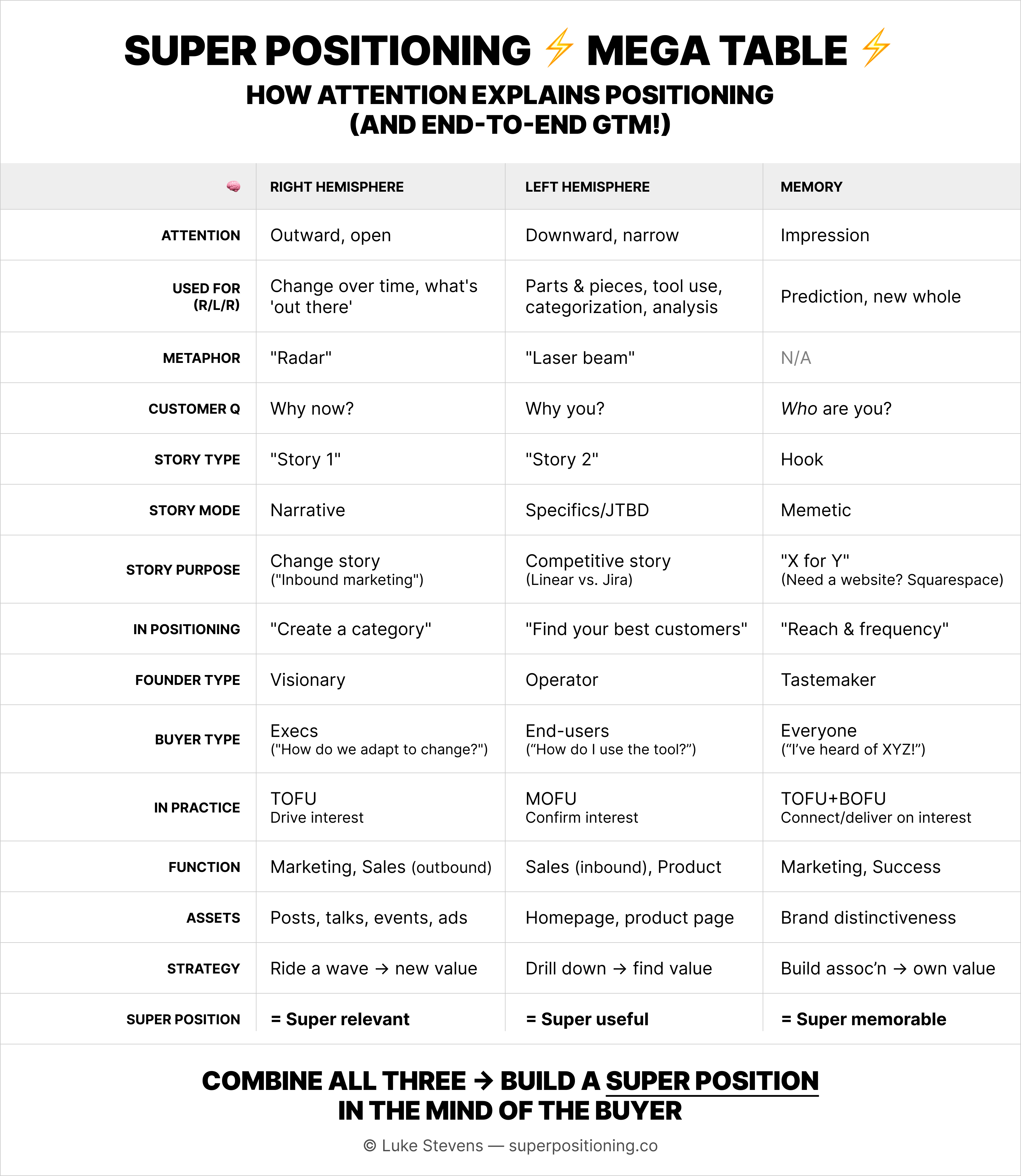
(Find me on LinkedIn for a full-res version of that image.)
Demand rules everything around me
That said, I want you thinking hard about your situation, not the framework for its own sake. The point of positioning is to find appropriate sources of demand that can satisfy the financial outcomes you want to achieve for your startup, and that will inevitably be unique to you.
Therefore, we’re going to take our new fundamentals of attention and turn them into a three-pronged framework for building a ‘super position’ in your market — a super position being the ultimate outcome every funded startup needs to achieve.
We’ll get hands-on with positioning and narrative exercises so you come away with something you can start testing with prospects and customers today if you’re particularly keen.
Positioning is the point
Building a position in the mind of your buyer — and your broader market — is, after your product, perhaps the most fundamental activity for any startup.
Building a position in the mind of your buyer is, in a sense, the entire reason your go-to-market operation exists at all — marketing, sales, success… all of it. The fundamental job of those functions is to ensure people know about, choose, and positively remember your product. That doesn’t happen by accident. It happens when you deliberately build that position in their mind!
The trick, however, is that someone has to align everyone around a shared narrative and message so that a clear, consistent, and coherent position actually gets built, and everyone doesn’t run off at a million miles an hour in different directions.
Therefore, we’re going to take a founder-led approach to positioning in this book — that’s why this is a ‘founder’s guide.’ Founders have ultimate decision-making responsibility, after all. They make the big calls and can spend the big bucks. But if you’re a marketer, seller, or product person, whether that’s as a leader or IC, there’s still loads of juicy ideas, frameworks, and step-by-step guides in the chapters ahead for you to use and abuse however you see fit.
Why another book on positioning?
Why not? For such an important topic it’s still relatively under-explored in any depth.
In a nutshell, positioning exists because competition exists, and given that businesses — and startups, especially — are always looking for new ways to compete, it makes sense that new approaches to positioning will emerge over time.
Here’s how I see where we’re at with positioning as a concept.
In the early years of positioning — think the 1970s, ’80s, and ’90s — the kitchen-sink approach was in. Writing about positioning meant writing about how anyone had positioned anything ever. That was inspiring, but not always very useful when it came to picking the right approach for your specific business.
In more recent times, especially in the 2010s B2B startup world, the specialist approach was in. People who had success with their very particular approach became famous for their approach. The result was a bunch of interesting positioning approaches (ones we’ll explore in the chapters ahead!) that often were as prescriptive as they were contradictory. One camp said you HAD to do it THIS EXACT WAY otherwise you were WRONG, while another said you had to do it a completely different way.
This was — for your humble author, at least — as confusing as it sounds!
For founders, marketers, and practitioners like myself, this gave us things to try, but if a given approach didn’t work, we were SOL. Worse, in some cases, these prescriptive approaches would actually be dangerous, sending teams down dead ends, wasting years of time and millions in capital.
So if we’ve had the kitchen-sink era, followed by the hyper-prescriptive specialist era, what comes next?
I believe it’s the fundamentals era backed by — you guessed it — modern neuroscience that explains how we fundamentally attend to the world.
The good news is that with new fundamentals, we can now put all those previous pieces in place. That in turn gives us new ways to compete, and therefore new ways for you to win.
Winning on strategy
Let’s be real: while the AI era may have given us a whole new range of possibilities to explore and technology to deploy, the nature of venture-backed startup positioning remains the same: it is different and it is hard.
It’s not about putting some marketing polish on a mature product in a stable market. It’s about big swings with big risks for big outcomes. Those billion-dollar outcomes don’t come easily, but why would they?
Likewise, the core truth of B2B remains the same: In B2B market strategy is (almost) everything.
In the B2C world, consumers are, almost by definition, a mass market. But the business world is almost fractal in its complexity — we sell to different roles, different functions, different verticals, vastly different business sizes… the list goes on.
To win in B2B markets, then, startups have to do two very different things at the same time: find the tightest, most efficient place to start selling into and maintain an expansive vision for what could be when you conquer your niche, vertical, or industry.
B2B startup positioning, therefore, requires pushing to the extremes — drilling right down to the best ‘ideal customer’ so you can start building momentum and looking out at what AI opportunities (for example) might reshape an entire industry.
Giving yourself the best chance of winning your market, therefore, means understanding how both of these very different approaches to positioning work. And that brings us back to the science.
The hole in the heart of positioning
Without a solid theory of the mind, we don’t have reliable fundamentals for creating meaningful positions in the mind.
Without those fundamentals, we’re left with either the kitchen-sink approach (a lucky dip from “Here’s everything that ever worked”), or the specialist approach (“Here’s what I’ve personally seen in my inherently limited experience”), but no fundamentals to help us choose the right approach that makes sense for you in your specific context.
I’ve seen what happens when this goes wrong. I was briefly at an extremely well-funded startup I’ll call The Unicorn. Big-name specialists were brought in to work on positioning problems they were ill-suited for, and hundreds of thousands of dollars later (along with hundreds of staff hours spent on implementation), there was very little to show for it.
This was positioning via consulting roulette, with each spin of the wheel costing six figures and months of distraction.
I thought that was insane. So I went on my own slightly insane journey, spending three years obsessing over the solution; over why some positioning approaches worked in some contexts and not in others.
The result is… well, you’re reading it! And the answer turned out to be a very simple idea.
The neuroscience of positioning
Competing in a new way, especially in the new AI age, requires fresh sources of wisdom and insight. In this book, we’ll be drawing from new-to-B2B neuroscience from one of the most fascinating intellectuals of our time: Dr. Iain McGilchrist.
McGilchrist is a psychiatrist, philosopher, neuroscientist, and author of some incredible books, but for our purposes, he’s also the creator of the ‘hierarchy of attention’ that gives us this new, first-principles approach to attention, specifically the two modes of attention we use to attend to the world in two quite different ways.
Attention seems like a small thing — it’s our focus; it’s what we pay to things; it’s why marketing is often seen as unserious because it’s just about ‘getting attention,’ as though that was trivial to do.
But attention is everything. It’s how we fundamentally exist in the world. Our entire existence is mediated through our attention. And the more we can understand that attention — and the two hemispheres of our brains that generate it — the more strategic and deliberate we can be in terms of how we use our own attention and engage the attention of others.
Put another way, in positioning terms, with a stronger understanding of the mind, we can now build a stronger position in the mind.
In a practical sense, this means we can unlock the attention of prospects in a new, first-principles way. And if we understand those fundamentals, we can then be strategic in how we build a super position, by making ourselves super relevant, super useful, super memorable — or, ideally, all three.
The way we do that is by being ultra clear about the three fundamental prongs of positioning that we’ll be working with as we go: your change story, your differentiation story, and your memorable hook — that one simple thing you want to be known for.
Introducing super positioning
In this little introduction, we’ve established that startup positioning is unique. We’ve established that we have new fundamentals of attention that are unique.
Combined, they give us a new framework.
I call this framework, as you might have guessed, super positioning.
Super positioning is designed specifically for B2B tech startups, especially on the SaaS and AI side, and was a product of necessity. I was (and am) a technically minded copywriter turned product marketing consultant, and my job was (and is!) to help startups define their positioning and turn that into a compelling pitch and messaging.
In the specialist era, it felt like everyone was arguing that their way was THE way because they found a pretty good hammer for their specific situation. You were either on TEAM HAMMER (niche!) or TEAM SCREWDRIVER (category!) or TEAM WRENCH (brand!) and you HAD to choose.
But what if we could all join TEAM TOOLBOX instead, and reach for a hammer, screwdriver, or wrench whenever it was appropriate for you?
Or better yet, what if you could use all those tools together in a way that built something greater than the sum of their parts? Wouldn’t that be more powerful?
That’s what super positioning is about, and that’s how I believe startups ultimately win. In some ways, this is a return to classic business strategy — make compounding choices that create a unique whole and defensible moat in the market. I also believe it’s the antidote to a lot of the superficial positioning advice that has plagued startups in recent years.
Why super positioning?
I call it “super” positioning mostly because it’s a framework that sits above traditional approaches (like “superscript”).
It’s not that the positioning specialists were wrong — in some ways, they were extremely correct! That’s why we’re going to cover their techniques! But the specialist approaches were often a case of the blind men and the elephant — each person confidently explaining what they could feel (a rope! a spear! a wall!), but without the broader understanding of the whole they couldn’t see (the presumably quite bemused elephant).
In Super Positioning, my aim is to bring our attention back to the elephant itself — the minds of the buyers we’re trying to engage with. This gives us a unified approach that sits above the traditional positioning approaches. (Yes, it’s a super position of positioning!) In my (extremely biased) view, super positioning, as a framework, should be the approach every funded startup should pursue by default.
Winning your market means creating a super position; super positioning is therefore the framework you use to win.
That’s how I see it, at least, but again, I’m biased!
The truth is, I just really, really love doing positioning. I love thinking through the strategic ideas, finding the right words, and turning simple pitches into strategic narratives and back again. By the end of this book, I hope you will, too.
This is the book for you if…
So is this the right book for you?
If you have a B2B product but are wondering where it fits, and how you can unlock that market half of product/market fit, then this is absolutely the book for you.
Likewise, if you’re someone who likes to get hands-on, do the thinking, and work on your own strategic narrative or pitch, then this is the book for you.
Finally, if you’ve heard of terms like category creation, narratives, niche positioning, ICPs, and brand, but wonder what the heck they mean, this is also the book for you.
Here’s how the book works.
How to use this book
The first half of this book is a crash course on the framework, followed by three positioning exercises that focus on your own positioning and strategic narrative.
The second half runs through four core positioning strategies, again intended to stretch your thinking about your own positioning, before finishing with the super positioning manifesto.
This is a choose-your-own-adventure book. Run your eye over the chapters below and dive in wherever you want. You do you!
Super positioning crash course
In the next chapter, we’ll get your origin story down, then I’ll run you through my hook test diagnostic. Following that, I’ll give you a crash course on the three prongs of super positioning: going big, going narrow, and going broad. Specifically, we’ll look at:
- Introducing super positioning: We’ll cover the two modes of attention that drive both this book and your quest to transcend your category and build a super position.
- Prong 1 — going big: Our first prong is built on right-brain change stories, and we’ll look at the origins of category creation and what it means to create a concept instead.
- Prong 2 — going narrow: Our second prong is built on left-brain narrow focus on a niche, and we’ll discuss customer vision vs. company vision.
- Prong 3 — going broad: Our third and final prong is built on memory, and we’ll borrow the idea of brand as memory association from the B2C world before bringing the three prongs together in some handy 2x2s.
Getting hands-on
Ideas are great, but ultimately you need to ship. Therefore, I’ve tried to design this book to be maximally useful in terms of helping you work out your own (super) positioning in a tangible way. To do that, we’ll work through your:
- Strategic specifics: In our first exercise, we’ll think through your ‘strategic specifics’ across our three dimensions: super relevant, super useful, or super memorable. You’ll come up with a positioning specifics score, and we’ll discuss your ‘positioning personality.’
- Strategic narrative: We’ll turn those specifics into a strategic narrative that everyone is aligned on, following my 10-slide outline.
- Strategic messaging: Finally, we’ll execute by applying your narrative to your website and customer-facing messaging, again following my outline and suggestions.
That is, we’ll think through your specifics, align around a narrative, and execute through your messaging. That’s the fastest and most effective way I can take you from being interested in positioning to having something live in the world you can get feedback on.
Going deeper
But maybe you need to go deeper. Maybe the problem is you’re not sure what should be driving your positioning in the first place. If that’s the case, I’ve got four super positioning strategies for you, with a bunch of examples to boot:
- Super relevant — ride it: Ride a wave (like the AI mega wave) and prove new value.
- Examples: Legal tech in AI (Hebbia, Harvey, and Spellbook), Glean, classic CRM winners (Salesforce, HubSpot, and Drift), and even some ‘category creators’ (Gainsight, Yammer, and Qualtrics).
- Super useful — find it: Find unique value in a niche.
- Examples: Qualtrics origin story, how ConvertKit got started, and Loom’s ‘user innovator’ discovery.
- Super memorable — own it: Own associated value in the market by building brand memories at scale.
- Examples: Clay, and a brief look at Squarespace, Slack, Linear, and Notion.
- Super positioning — combine it: Create a super position by combining the other three strategies.
- Examples: Figma on the PLG side and Qualtrics again on the sales-led side.
Why “super” everything? Because startups that win need to be — to borrow the Jobs-ism — insanely great. So maybe “super” is underselling it — maybe you should be insanely relevant, insanely useful, and insanely memorable. Either way, that starts with your product and ends with your positioning. And as far as how this book ends, we’ll conclude with my short and sweet super positioning manifesto.
That’s it, that’s the book!
I’ve spent much of the last three years squeezing every positioning idea I can out of my brain, throwing away 80% of it, and leaving you with the juiciest, most potent ideas focused on helping you build your super position in your specific context.
I’m super excited about what we’re going to cover in the chapters ahead. I promise that you won’t look at your market, positioning, or narrative the same way again.
Next, let’s discuss your origin story (and mine).

Thanks for reading — let's chat! :)
Enjoying the book?
Buy on Amazon →